
by Razelyn Macuja | illustrated by Art Antaran
My mother’s love letter does not come in sweet words. They do not declare ’I love you’ in bold letters. But they ensure that I can eat. That I can study. That I can remain in this unfamiliar town long enough that it feels like home.
When I left for college, I moved to a town where the dialect rolled off people’s tongue differently. Where I’d always take that brief pause to think every time the tricycle driver asks me where I’m headed to. Walking unfamiliar streets. For the first time, no one reminded me of turning the stove off or to check if the door and windows are locked.
Adulthood did not ease its way into my life. It crashed onto me in the form of rent due dates and electricity bills slipped under the door.
Electricity bills due on the fifth, water on the tenth, and rent loomed like a deadline I couldn’t reason out with “I’ll do it tomorrow”. Groceries had to stretch across the weeks. Laundry piled up inside the basket, estimating if it’ll pass through the kilogram limit. Even illness had its own price—checkups, medicine, and transport.
We become prematurely hyper-independent. Learning to cook for one. Changing light bulbs with the help of youtube tutorials. Navigating roads with google maps. Sitting alone in clinics. Celebrating every small win quietly—surviving a brutal week and passing a long exam that felt like war.
Along with figuring life out, I learned how survival comes in small calculations. Walking to my dorm instead of taking the trike, checking the posted menu of a restaurant on their facebook page before deciding where to eat, and cutting grocery lists, buying less of something just to extend my allowance for a few more days.
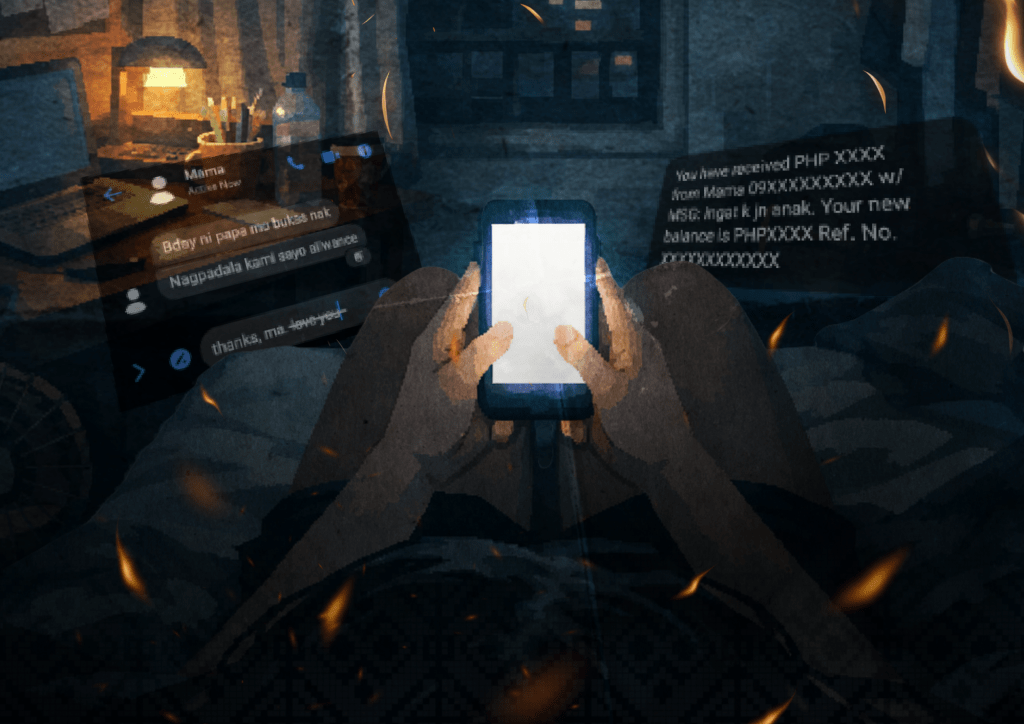
And just before as anxiety began to tighten its grip, my phone would light up with a notification.
“You’ve received xxxx pesos from [name]”
No heart emojis. No paragraph of how much she misses me. No “ingat, anak” trailing at the end—just pure numbers, exact, calculated, and necessary.
The first time I saw that message while living alone, I didn’t smile. I cried. Not because it was sweet, but because I could pay my rent before my landlord came knocking, the faucets wouldn’t dry up, and the lights would stay on.
Living in this kind of setup, I became more fluent in ‘thank yous’ rather than ‘I love yous’. I grew up mastering gratitude, because we know that the sacrifices are immense. We are told, repeatedly, that everything is “para sa’yo.” For you.
But, gratitude doesn’t cancel out longing.
There are nights that the unfamiliar town feels heavier than usual—the rain pours louder on the roof, when a long exam leaves me in my room doubting my worth, when loneliness seeps through the cracks of independence. In these moments, it’s not money that I want, but presence.
There is an invisible accounting system in a family like ours, where presence is one of the most expensive things to wish for. There exists a system of two sides of everyone’s reality. On the first one: grocery receipts, WI-FI fees, rent payments, medical bills, and transportation fares. On the other: missed birthdays, unattended school meetings, empty seats during school events, the kind of absence that lingers in family photos.
So we just compromise, we accept provision in place of proximity. We trade the warmth of a hug for the security of a cleared balance.
And still, at least twice a month, the message arrives. Like a gentle tap on the shoulder, a reminder that I may be facing life alone, but not truly alone.
The message says without saying: I am still here.
It says: I’m working so you can keep going.
It says: You’ll survive today.
Somewhere between oceans and time zones, my mother calculates exchange rates. She trims her own wants until just the necessary remains. And for whatever is left travels across borders and arrives in my bank account.
My mother’s love did not arrive in handwritten letters sealed with perfumes. It came in exact amounts—never too late, rarely too early. It came in the form of overtime work, aching back, and homesickness swallowed in a foreign kitchen.
For every time that my phone lights up, the distance between us compresses into a single notification.
The “xxxx pesos” aren’t just numbers, they are a piece of her time, converted into a currency I can swallow. It is the sound of her alarm going off early in the morning to face life in a city that doesn’t know her name, just so I could sleep soundly in a town that is slowly learning mine.
It is easy to romanticize love from afar. It is harder to sit with its cost. There are years that we didn’t share the same roof. Inside jokes we missed creating. Ordinary afternoons that will never be recovered. Because love in our case, is not measured by the time we spent together, rather it is measured in time bought for the future.
My mother’s love letter does not come in sweet words. They do not declare ’I love you’ in bold letters. But they ensure that I can eat. That I can study. That I can remain in this unfamiliar town long enough that it feels like home.
We’re used to thinking that love letters are always something poetic—longing words, pages filled with ‘I love yous,‘ ink bleeding into paper. But sometimes it comes in numbers, in bank account transfers. And somehow, being tangled up in this messy version of adulthood, I have learned that a bank confirmation is a prayer answered in digits. It doesn’t straight up say “I love you,” what it conveys is the message that I’ll last another month, and for now, that is the same thing.
Razelyn R. Macuja is a first year BS Statistics student and feature writer with an eye for the overlooked. She writes tender, observant pieces about the quiet chaos of campus life, finding meaning in the small ordinary struggles of the student body.

 Pagbutlak
Leave a comment