
by Ella Villodres | Graphics by Klyde Factes
Social media platforms are not neutral hosts of content. They do not merely “reflect” culture—they curate it, deciding which versions of women’s bodies are profitable, and which are punishable. In doing so, they mirror the very systems that shaped them—just faster, wider, and at a much broader scale.
In today’s society, a woman’s body is never just a body. It is both desired and judged. It is both a spectacle and something to be sexualized.
And in Kristina Mutia’s article ‘Bontok the “rape-less” society,’ she challenged the current culture of sexualization through the lens of the Bontok people. There, an indigenous narrative was anchored: that a woman’s body is not an object of shame, but a site of power, ancestry, and resistance.
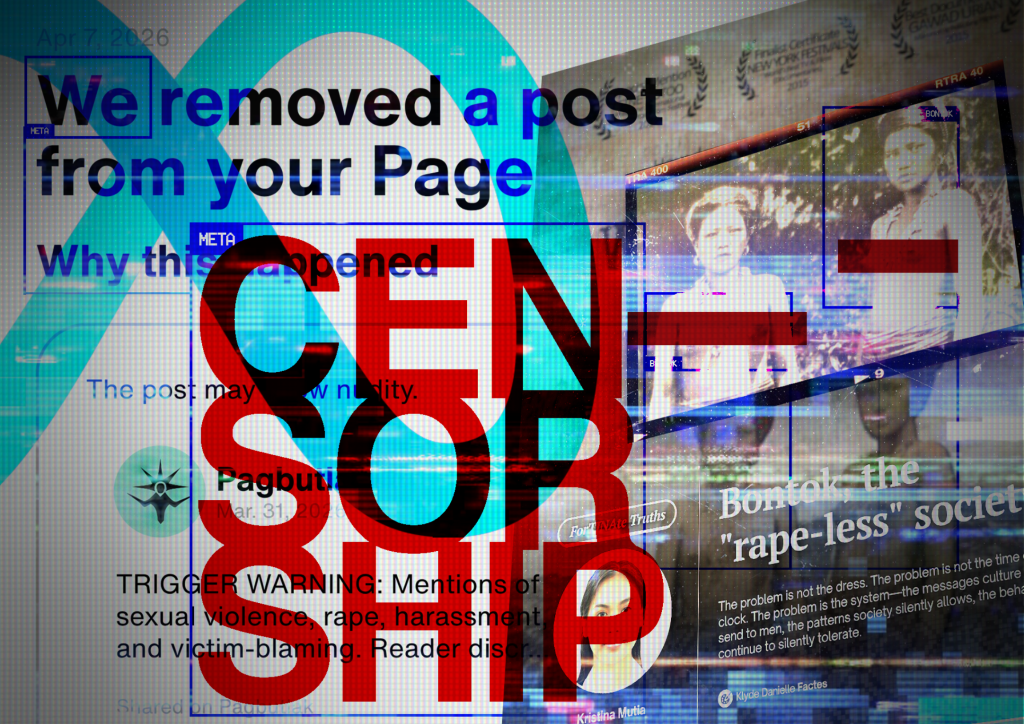
But in a twist too ironic (and too alarming) to be accidental, the very platform that claims to hold space for conversation, chose censorship. On April 7, an article on the reclamation of the female body was taken down by Meta—on the grounds of “nudity.”
From where I stand in the newsroom, this is not something to be taken lightly. I write this not just as the 51st Editor-In-Chief of the publication but as a woman, and as an activist who believes that women’s liberation does not exist in isolation.
It is alarming that just days after Women’s Month, a piece that explicitly critiques the sexualization of women’s bodies—one that situates nudity within a cultural context—was reduced to the very thing it was interrogating.
With Pagbutlak grounded in the principles of press freedom and mass-oriented resistance, the entire newsroom was deeply unsettled. The Editorial Board sent appeals. They were denied. This was especially questionable given that Meta was able to restore 591,000 content flagged as sexual or nudity violations last year–even without appeal. But alas, the decision stood, rigid and unyielding.
And in doing so, Meta proved the article right.
Because what does it mean when a narrative about women reclaiming their bodies is flagged not for misinformation nor for harm, but for visibility?
It reveals a culture of censorship and sexualization built on systems so entrenched they can silence criticisms. Systems working in tandem to blur the lines between objectification and agency, between exploitation and resistance. Systems where the mere depiction—be it a discussion or a simple imagery—of women’s bare bodies is automatically coded as inappropriate, regardless of context.
Societies and systems: Situating the culture of sexualization
In Tina’s piece, the act of Bontok women exposing themselves is not sexual, but something historical and cultural. Their culture, contrasting ours, recognized women not as objects of desire but as bearers of agency.
In it, a boundary was drawn in the most visceral way possible: that a woman’s body is not anyone’s to take or degrade. So when stripped off of that critical context—flattened by “algorithmic moderation”—what once was a narrative of resistance was distorted into mere “content violation.”
Not just ironic and infuriating, the censorship is also very telling.
It tells us that the problem of sexualization was never just about individual acts of objectification—never just the offhand remarks of public officials or isolated bad faith actors. It is actually embedded deeper within our culture, in our society: within the very infrastructures that dictate what we see and what we are allowed to say.
In other words, our cultures—encompassing our ideas and behaviors—are defined, shaped, and reinforced by the interwoven systems that govern us.
Algorithms as systems of amplification
From the latest transparency report of Meta, it was found that of every 10,000 content views, an estimate of 10 to 11 would contain sexual and nudity violations. But Meta is not alone in hosting this culture of sexualization and censorship. Across other platforms, the pattern’s the same.
On sites like X, for instance, tools such as Grok AI has streamlined sexual harassment in ways that’s become harder to stomach—images can now be manipulated by strangers, where women can be undressed in seconds through AI.
At the same time, in these platforms (X in particular), pornographic and exploitative content circulates freely, amplified by algorithms designed for engagement. We see that what is sexualized is rewarded while content that resists this sexualization is suppressed.
Social media platforms are not neutral hosts of content. They do not merely “reflect” culture—they curate it, deciding which versions of women’s bodies are profitable, and which are punishable. In doing so, they mirror the very systems that shaped them—just faster, wider, and at a much broader scale.
However, in the grand scheme of things, they are but a strand in a web of interlocking systems that sustain this culture of sexualization.
What’s and y’s: Women’s oppression through misogyny and patriarchy
When harm against a group of people is not random but repeated, that harm becomes culture in of itself. When it’s normalized, socialized, and institutionalized, we call it for what it is: oppression.
(1)The oppression of women is systemic. And it has a name: misogyny.
Oppression is no one-time act. It is a system of systems working together. We see this when harms are embedded from across social media to culture, to history, to politics, and beyond.
In media and culture, we see it became a norm for men to casually reduce women to “cum receptacles” or as the “subservient” gender to be dismissed.
In our politics, male politicians can publicly degrade actresses and female leaders with no consequences while the policies in place remain insufficient to safeguard women’s rights and welfare.
(2)The oppression of women is structured. It is upheld by patriarchy.
Patriarchy is not a secret monthly meeting of all men convening to craft new creative ways to degrade women. It is a system of hierarchy. And hierarchies survive and gain legitimacy by manufacturing inferiority. They need to convince us that this made-up order is natural, deserved, and even inevitable.
Through media, culture, or religion (or any system, really), patriarchy thrives through narratives where women are deemed lesser beings that ought to “surrender to men.”. And one of the most consistent sites of control has always been our bodies—the most immediate and tangible assertion of autonomy that a woman can possess.
We see that control when women are treated as property, exchanged for livestock or bartered for alliance between families. We see that in the way a woman’s worth is measured by the amount of fabric on her body—as if respect is something she must earn through modesty. We see this in the culture that upholds female virginity and purity, while men are praised for their promiscuity. We see that when a woman’s value is tied solely to her life-giving ability, where childless women are shamed as less-worthy.
And we saw that just this Women’s Month, where transwomen’s stories were silenced and womanhood remains confined to rigid chromosomal and flesh-bound standards.
But womanhood is not defined by one’s biology, “modesty”, or fertility. It is lived, shaped—and as a social construct often weaponized by controlling patriarchal narratives, firmly confronted and redefined.
For the love of -ism’s: Control Consolidated by Colonialism, Capitalism, and Imperialism
(3)The oppression of women is capitalistic.
In today’s digital age, women’s bodies are not only controlled but also commodified.
Platforms pick and choose when women’s bodies are profitable and when they are “inappropriate.” Pornographic content made for the male gaze is amplified when it generates engagements, clicks, and revenue. But somehow, when women speak about their bodies in ways that challenge the status quo—when they critique, reclaim or resist—they are silenced.
It just adds another layer of anger when the system does not only reinforce and allow harm but actually profit from it.
(4)The oppression of women is also colonial.
Before colonial rule, the communities in the Philippines were historically more egalitarian. Just like in Bontoc, women held roles of leadership, spirituality, and agency. But centuries of colonization—from the Spaniards to the Americans and to the Japanese—gutted indigenous ways of living, enforced new hierarchies, new moral codes, and ways of controlling the female body.
Filipina bodies became sites of colonial violence—from religiously enforced modesty of the Spaniards to our brutal history of “comfort women” during the Japanese occupation.
Proven by Meta’s censorship, indigenous practices like that of the Bontoks—that have long been pushed to the margins—continue to be shamed and erased.
(5) The oppression of women is also not isolated from imperialism.
Though the Philippines may be “free” on paper, colonialism persists in more subtle but no less violent forms—through continued exploitation and extraction. The U.S. continues to exert its influence, not by genuinely enabling industrialization or national sovereignty after it “granted us independence,” but by shaping systems that kept the country dependent.
Among these is an education system adopted after the Hampton-Tuskegee model (used for the formally enslaved African-Americans), whose curriculum emphasized manual labor over critical, liberating education. Over time, this system evolved not to shape nation-builders but to produce labor for export: English-speaking, globally employable workers who are trained to fit into foreign economies and industries rather than develop our own.
Thus we see Filipina daughters and mothers separated from their families, pushed abroad by the lack of opportunities, low wages, and underdeveloped industries at home. Many migrate to the Middle East, where their care and labor are commodified—valued only insofar as they can serve. For in these foreign lands, they face constant risks: abuse, exploitative contracts, the precarity of scams leaving one undocumented, and rising geopolitical tensions.
And so when conflict erupts, they are never spared.
We see this in the US-Israel war on Iran, where innocent civilians are ultimately caught in the crossfire. We have also seen this in the tragic sacrifice of a Filipina caregiver by a missile, as she spent her final moments trying to protect the elderly person under her care.
This is what imperialism looks like today: not always in imperial flags planted on foreign land, but in Iranian schoolgirls brutally decimated, care labor from the global south extracted, and lives treated as expendable.
More than just a censorship but a system exposed
I could be callous and throw obscenities at Meta and its AI—type out a quick “p*t*ng ina mo, Meta” in our editorial board group chat, berate that “motherf*ck*ng AI” and call it a day.
But even in the pause where I caught myself mid-curse revealed something sinister.
Because even the language we reach for in times of anger is not neutral. It too is not spared from the clutches of misogyny. Curses like “son of a b*tch” or “motherf*ck*r” hinge on degrading women, on turning womanhood into insults. Even in our vocabulary, the culture of sexualization and oppression lingers.
It’s clear: women’s oppression is not confined to one platform, one policy or one moment of censorship. It is systemic—threaded through our language, our social media platforms, our institutions, our histories, and our economies. It shows up in algorithms unable to (or purposely designed not to) tell the difference between exploitation and resistance. It shows up in cultures that control women’s bodies while profiting off of them. It shows up in global systems that extract labor from Filipina women while rendering their lives expendable.
This was never just about an article being taken down but what it reveals.
It reveals how social media platforms and their designs are reflections of the systems in which they were developed. It reveals a world where women’s bodies are still easier to censor than to protect. It reveals interlinking systems of oppression that would rather silence critique than confront the conditions that birthed that very critique.
Because if an article of resistance can be flattened into content violation, then what else were we also never meant to see?
And what stories of resistance are being censored before we even have the chance to read them?
Mariella Villodres is the 51st Editor-in-chief of Pagbutlak. She is currently on her junior year as an applied mathematics major at the Division of Physical Sciences and Mathematics.

 Pagbutlak
Leave a comment