
After 17 hours on a gurney, that was impossible to ignore. Emergency rooms stretched beyond design, patients waiting in hallways, procedures delayed not because care is absent, but because capacity is already spent before the next patient even arrives. This is not unique to my experience especially in over capacitated health institutions across the country.
I’ve never liked hospitals. While other people see them as places of healing, I’ve always seen them as spaces where fear lingers in the air—the smell of alcohol, the harsh fluorescent lights, the kind of silence that never really feels quiet.
But on an ordinary day that turned anything but, I stopped being an outsider afraid of hospitals and became just another body inside one.
Hour 1
I arrived at the emergency room unable to stand straight because of the pain. The first thing I learned was that there were no beds left. The nurses moved quickly around me while asking questions they had probably asked hundreds of times that day already. Someone injected painkillers into my veins (or arteries, I don’t know). Someone else looked for a place where they could temporarily leave me. Around us, stretchers lined the hallways while watchers stood shoulder to shoulder beside patients.
I remember thinking how strange it was that overcrowding already felt normal there.
Hour 2
The stretcher I used wasn’t even from the hospital. It was borrowed from the ambulance that brought me there because the emergency room had already run out of gurneys.
As they rolled me through the hallways, all I could really see was the ceiling and all I could bring myself to hear were footsteps moving constantly around me. Nurses carried trays, folders, medicine, oxygen tanks. Doctors stood at packed stations while several watchers spoke to them all at once.
Nobody looked calm. Nobody looked rested. The emergency room wasn’t the chaotic, dramatic, explosive scene often shown on television. It was quieter than that. It was more restrained, more exhausting.
Hour 3
They parked my stretcher near a wall and lowered it until I was almost level with the floor. People kept reaching over me for files and supplies stored nearby. Every few minutes, someone would gently move my gurney aside to make room. I remember feeling embarrassed at first, like I had become an obstacle in the middle of the hallway.
Then I realized everybody there probably felt that way.
In overcrowded hospitals, people slowly stop becoming individuals and start becoming numbers waiting to be processed. One more chart. One more patient. One more person needing attention in a room where there is already too much suffering for too few workers to handle.
Hour 5
Tests blurred together after a while. Blood extraction. Ultrasound. IV insertion.
At some point, I stopped asking questions and simply followed instructions because I could see how hard everyone was trying to keep the system moving.
One nurse rushed from my bedside to assist another patient before returning minutes later to continue what she had started with me. Another staff member was eating crackers behind the station while writing notes at the same time, probably because it was the only chance they had to eat at all.
There is a different kind of exhaustion that comes from caring for too many people at once. And that exhaustion was loudly abundant in that room.
Hour 7
The trauma room lived up to its name. New patients kept arriving, some in far worse condition than me. One road accident victim was placed on a hard bench, still bleeding, because there was simply nowhere else to put him at that moment.
Outside the room, frustrated watchers crowded around the doctors’ station demanding attention for their loved ones. Inside, everything kept moving but nothing felt like it was moving fast enough.
Hour 8
Only one watcher was allowed to stay because the room had become too crowded, so my father had to leave. To my left was a child playing with one hand while an IV line was attached to the other. To my right was an old man breathing carefully through a rusting oxygen tank.
In between all of us were health workers trying to keep everyone stable at the same time. That was the moment I stopped seeing my experience as just my own. Everyone there was waiting for something—results, treatment, relief, survival.
Hour 10
The doctors finally returned with my results. The twist had gone on too long. Surgery needed to happen immediately. But “immediately” in a public hospital still meant waiting.
Another nurse apologized to me for the delay. I wanted to tell her she did not need to say sorry.
Because after hours of watching the ER operate, it was obvious that the people inside were already giving everything they could.
Hour 15
Another emergency case arrived, more urgent than mine, so my operation was pushed back again. Nobody argued with the decision. In public hospitals, everybody understands that someone else might always need saving first.
By sunrise, the ER looked even more tired than it had the night before. Some of the same nurses were still there, still moving from bed to bed, still answering questions, still working under fluorescent lights that never turned off.
Meanwhile, I had spent the night simply trying to endure it. They spent the night carrying it.
Hour 16
I was finally transferred from the borrowed gurney onto an actual hospital bed in the ward. As a nurse, whose name I can no longer recall, prepared me for surgery, something settled in me that stayed long after the operation itself: I was leaving the emergency room, but they were not.
Their shift did not end with mine.
Hour 17 and beyond
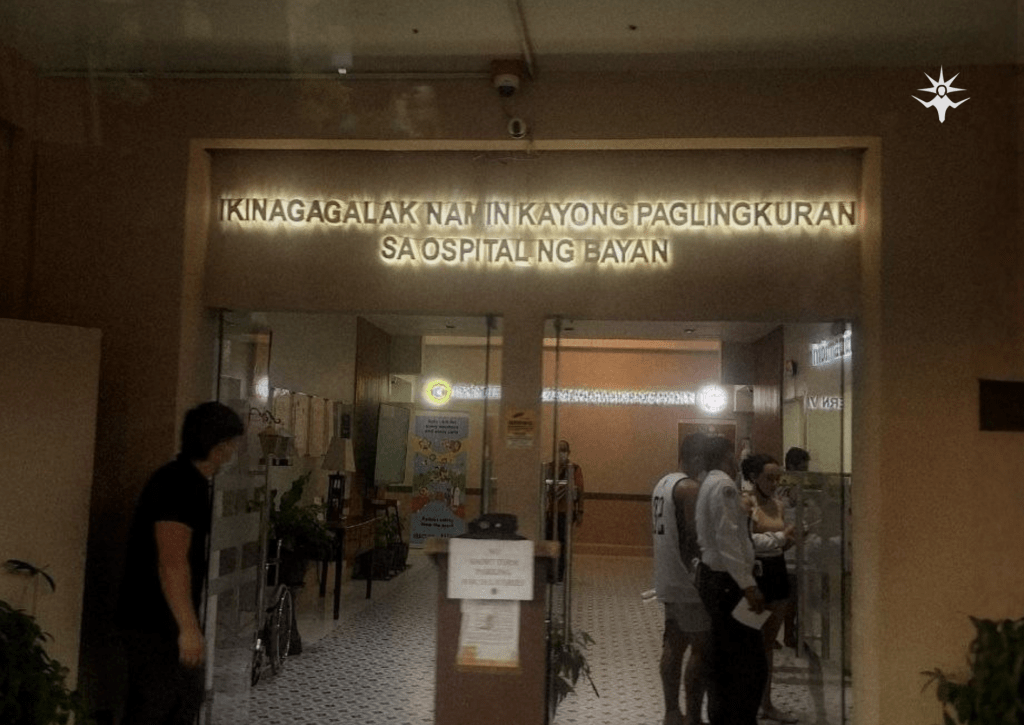
At the hospital gate, a sign reads: “Ikinagagalak namin kayong paglingkuran sa ospital ng bayan.” It is a promise of service, of care given with pride (and rightfully so). But after 17 hours inside a public hospital, that line felt less like a statement of reality and more like something the system was still trying to live up to.
National estimates show only about 21 healthcare workers per 10,000 people, far below global recommendations, with thousands more needed just to meet basic service demand. Nurses continue leaving for better-paying jobs abroad or burning out locally, worsening already thin staffing in public institutions.
Beds are just as scarce. The Philippines has only about 0.5 hospital beds per 1,000 people, and its public hospitals remain far below required capacity. The Department of Health itself has acknowledged the need to nearly triple hospital bed capacity to address congestion, while staffing gaps leave nurses handling more patients than safe standards allow, often beyond more than they should have per shift.
After 17 hours on a gurney, that was impossible to ignore. Emergency rooms stretched beyond design, patients waiting in hallways, procedures delayed not because care is absent, but because capacity is already spent before the next patient even arrives. This is not unique to my experience especially in over capacitated health institutions across the country.
As I was wheeled toward the operating theater, one thing stayed clear. We are all trapped in the same neglect. The only difference is that after seventeen hours, my shift as a patient ended and I got to leave. They had to stay for the next one.

Phil Liam Nono is a junior statistics student under the Department of Physical Sciences and Mathematics. He joined Pagbutlak as a news staffer during his freshman year and previously served as its 50th Editor-in-Chief. Currently, he serves as the Associate Editor for Internals particularly writing for the News and Cultures sections.



 Pagbutlak
Leave a comment