
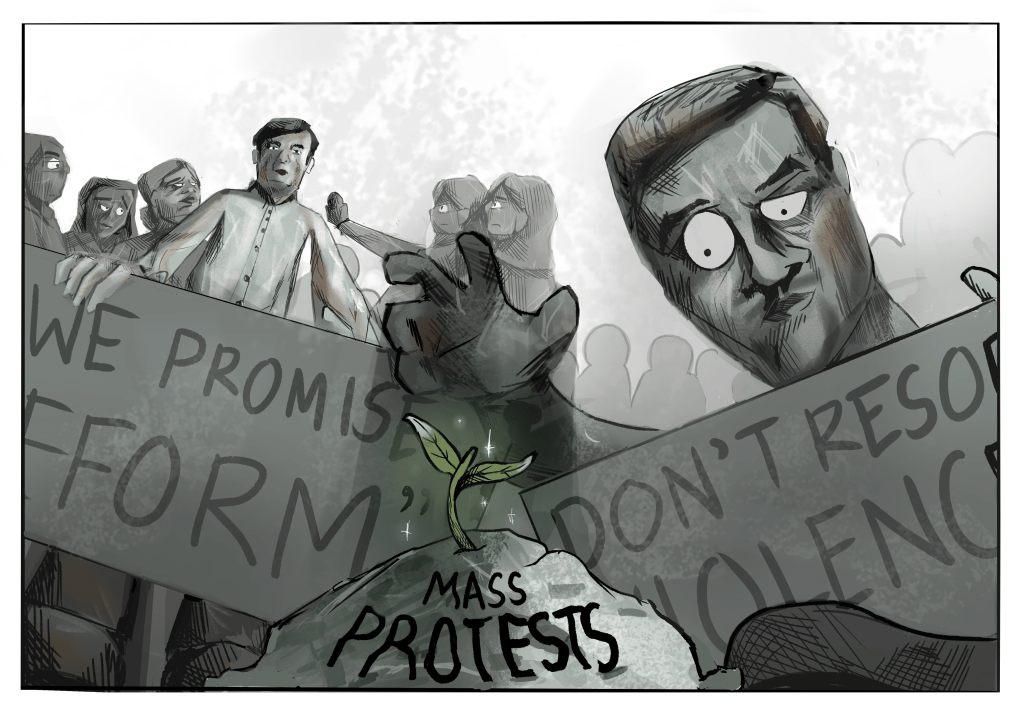
Cartoon by Steven Arcallo
Politicians position themselves as simply being “objective” or “impartial,” but all their moves are actually calculated survival tactics meant to manipulate the masses.
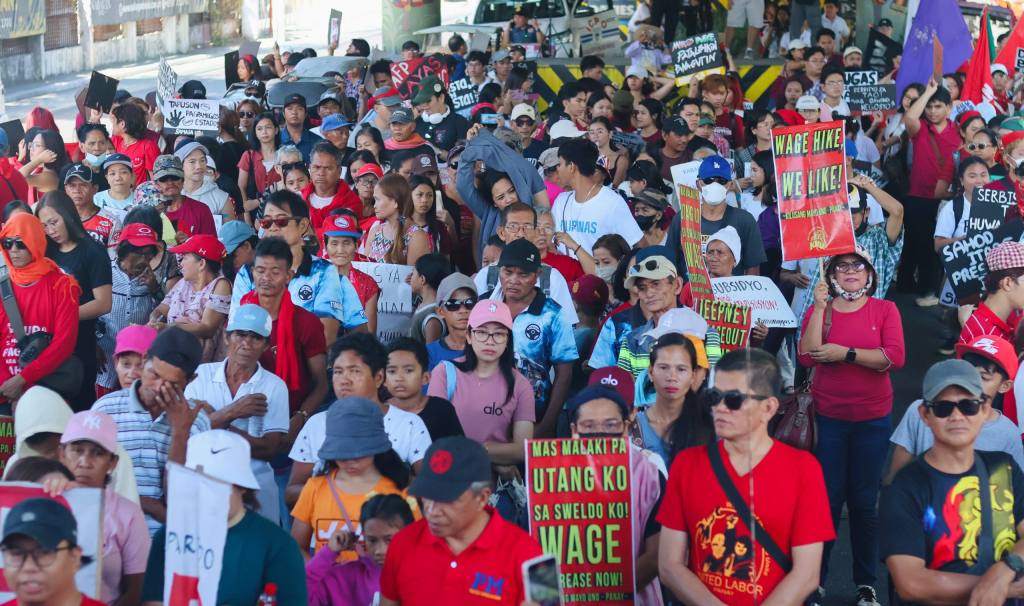
On September 21, 2025—marking the 52nd anniversary of the declaration of Martial Law—tens of thousands of Filipinos flooded the streets in one of the largest anti-corruption protests in Philippine history.
What began as a coordinated call for accountability quickly unraveled into a day of human rights violations and state repression. Over 200 protesters were arrested, and armed clashes with law enforcement broke out at different points in Metro Manila. The protests were sparked by mounting public outrage over the revelation of ghost infrastructure projects and flood control scams by government agencies.
Yet, instead of confronting their exposed corruption, officials responded by issuing subpoenas to student leaders all while calling for “peace,” ignoring the very injustices that fueled the nationwide unrest.
This pattern of deflection was reminiscent of the previous protest at the St. Gerrard Construction firm, where citizens—in a desperate attempt to seek justice—hurled mud and painted “magnanakaw” across their company gates. Owned by Sarah Discaya, whose family is linked to top DPWH contractors accused of siphoning billions through ghost projects and substandard infrastructure, their firm became a symbol of unchecked impunity. But even amidst this raw public outcry, just like the September 21 protests, many of our leaders chose the comfort of play-safe politics over upholding accountability.
Pasig Mayor Vico Sotto, often praised for his progressive-leaning reputation, disappointed many when he told protesters to “not resort to violence” and expressed how accountability has no shortcuts. While he promised legal action, his statement ultimately veered away from the rampant corruption and toward the behavior of the protesters. It was a familiar refrain—a politician has once again prioritized optics over outrage.
His statement faded into the usual chorus of “violence is not the answer” from many of our public officials. These, however, wrapped in toxic positivity, do little to address the rot at the core of our institutions. Instead, they redirect the spotlight from systemic abuse to the reactivity of those most harmed by it.
This isn’t an isolated case. Even President Marcos Jr., while naming top flood control contractors in one of his speeches, failed to call out the political figures tied to them—like Zaldy Co and the Discaya family—opting instead for vague promises of reform.
The message is clear: protest is acceptable only when it’s “peaceful”—hushed into whispers, subdued into meek faces, and stripped down to docile actions.
Play-safe politics thrive on ambiguity and performance. It’s saying just enough to appear principled, all while putting little to no effort into eradicating the deeply entrenched evils within systems. It relies on shallow vows, sanitized language, and ironically, a lofty sense of morality that shifts the attention away from the urgency of action onto the grooming of their political image.
Politicians position themselves as simply being “objective” or “impartial,” but all their moves are actually calculated survival tactics meant to manipulate the masses. By avoiding confrontation with the true perpetrators, they are able to preserve beneficial relationships, protect their reputations, and maintain their own political capital.
The comfort it offers goes beyond emotional security; it shields them from public backlash while enabling injustice to take root under a polished surface.
But play-safe statements are not neutral; they are strategic. They allow politicians to appear “supportive” while avoiding the risk of alienating powerful allies. They pacify the public with platitudes, all while maintaining the status quo—preserving the machinery of political mediocrity, personality cults, and strategic silence. Even worse, they subtly criminalize dissent, painting protesters appear uncivilized rather than people exercising their right to demand justice.
For example, Mayor Sotto’s call for peaceful protest, though possibly well-intentioned, echoed a broader pattern: the tendency of public officials to treat protest as a public relations crisis rather than a symptom of institutional failure. His warning that protest actions may only cause harm to the workers or protesters—while technically true—ignores the deeper damage inflicted by the systemic corruption permeating the state.
Public officials should be at the forefront of the fight against systemic corruption. They should be the first to ask why a top contractor declared zero gross revenue to the LGU, not the last to react when citizens take to the streets. They should be the ones leading investigations, not issuing PR-trained statements that say protests are ineffective, unnecessary, or dangerous.
If we continue to accept play-safe politics, we normalize a system where the burden of accountability falls on the masses, not the perpetrators. We allow corruption to flourish behind a velvet curtain of civility, while those who push back are punished for being “too loud” or “violent.”
For most, violent protest is not ideal. I deem it necessary. Faced by the blatant deception of our so-called public servants—who shamelessly wash their hands of guilt by stifling dissent and deliberately sabotaging investigations—outrage is not just inevitable; it is justified. The real violence lies not in the protests, but in the stolen futures, the flooded homes, and the silenced voices.
If institutions persist in sanitizing public outrage, these protests will escalate and grow more disruptive. When those in power refuse to face the root causes of systemic failures, they leave the marginalized, those most devastated by their corruption and abuse, with no chance.
To dismiss dissent as uncivilized acts or inconveniences is to ignore the very pulse of democracy. These expressions of anger should not be seen as mere “threats,” they are signs of life in a system gasping for accountability. It is this kind of defiance, especially from those pushed to the margins, that preserves the essence of democratic ideals. Unless both the government and public begin to recognize the legitimacy of what these protests call for, the rupture between institutions and the people will only continue to widen.
Protest is not the enemy. But every time a public official chooses to pacify rather than confront, they become part of the machinery that keeps corruption alive in the country.
Joena Bautista (or Wanders) is a junior of BS in Statistics. She joined Pagbutlak in 2023 as an opinion writer.


 Pagbutlak
Leave a comment