
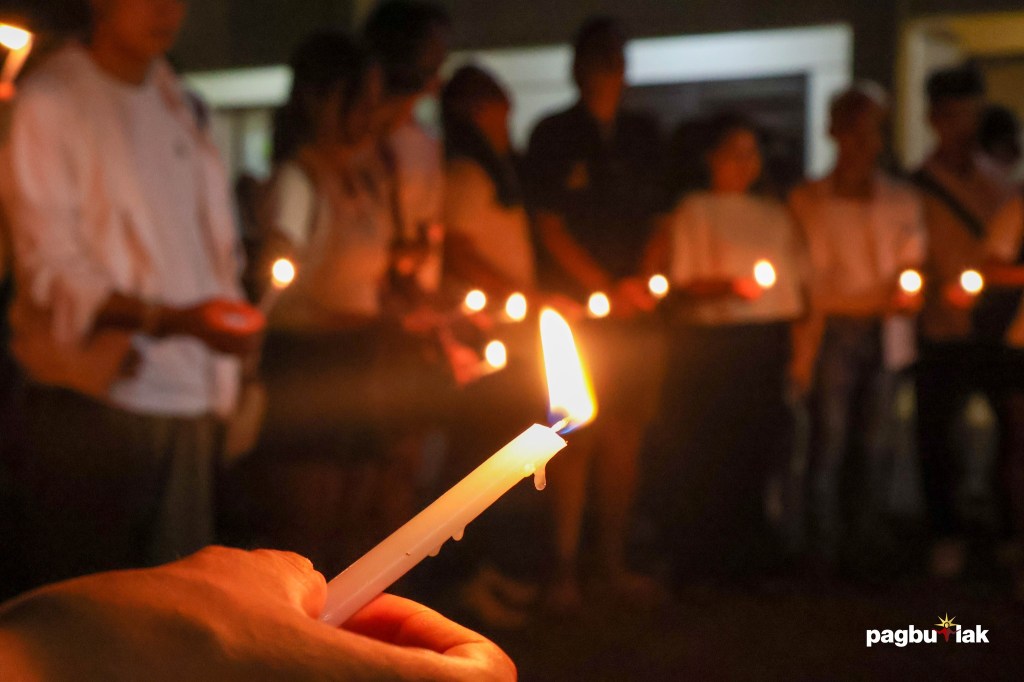
File Photo/Pagbutlak
Maybe that’s the strange appeal of UP, it teaches you to grieve and counter-attack, you live, you dream, yet you die, grieve and survive often at the same time without extinguishing the candles that you lit on the gravestone.
They say grief ends when you’ve fully embraced acceptance, yet no one tells you that oftentimes what you’re grieving isn’t a person, but a part of who you are.
Every November 2, the nation mourns the dead. Yet, as I entered the University of the Philippines, I’ve learned that grief walks in many forms — and sometimes, it journeys with us while disguised as strength and resilience.
Hunched backs, loud yawns and eyes that trace crimson at 2 am, hearing the loud clatter of keyboards that reflects not restlessness but of silent panic. The trace of bitter grief as they mutter; “Kaya ko pa ah,” even when their bodies feel like falling apart. A part of them dies with the dreams that merit alone cannot sustain.
I myself used to believe that everything in UP was a dream. A dream that lives on from the years of hard work and endless cycle of success, yet living through this, I saw how immeasurably life’s sparkle died together with success I once owned. Now, I sit in the graveyard of aspirations — that the same system that prides itself on equality is quietly haunted by the same ghosts it tries to resist: privilege, connections, and the invisible safety nets that not everyone has.
The stories that arose were too naive, too deceiving. We believed the stories, that this was the place where hard work and passion could rewrite anyone’s destiny. I was proud, too. Proud to have made it here, proud to be an Iskolar ng Bayan. But, the title comes with a price. The exhaustion drains from the bumpy tricycle ride back to the dorms, attached with the feeling of disappointment that hard work has not paid off. Midterm examinations have crushed students believing that this life was far from over.
During high school, we excelled in our classes. We possessed assurance, uniformity, and clarity. However, in college, the concept of excellence quickly seems relative. Striving alone isn’t sufficient, and survival frequently relies on factors beyond just ability. I’ve witnessed it firsthand, the gap between those who learn while stressing over rent and those who can afford to stumble because they have safety nets available at home. The instilled motivation drives each person to their own graves knowing that no matter how much effort they put in, it will all be replaced by the stillness and silence in unmatched opportunities and resources.
At times, grief in UP isn’t related to death. It’s about witnessing dreams crumble under the pressure of fatigue, observing enthusiasm diminish as survival comes first. It’s about understanding that not everyone is granted the same opportunities for second chances. And maybe the harshest sorrow of all is realizing that while we exhaust ourselves to demonstrate our value, others never needed to. We mourn the idea that merit by itself could support us. We mourn the purity that used to believe in “Kapoy lang ni.” We mourn the parts of ourselves that once thought this university was an equalizer, rather than a mirror revealing the struggles beyond its gates.
Grief appears uniquely for each individual — seen in sleepless nights that extend into morning, in students who laugh heartily yet bear invisible struggles, and in those who silently fade from classes without warning. For some, it manifests as burnout masked as productivity; for others, it’s the silent acceptance of understanding that their best might never suffice in a system established on shaky foundations.
It resides in the tambayans where laughter serves as a survival strategy, in the artworks and organization initiatives that reflect desire, and in the activism that converts grief into unity. Grief resembles the student who continues to attend classes despite being weary, the individual who conceals their pain through high performance, and the one who discovers solace in minor achievements that no score can quantify. Every narrative possesses its unique perspective — some mourn quietly, while others express their pain through defiance — yet they all embrace a shared reality: that existence and education in UP involve facing loss repeatedly, and continually rising anew from its weight
Amidst the imbalance, I understood something raw but powerful. It felt as if something stronger than despair, sorrow turning into defiance and fatigue transforming to empathy. I watch students pass notes instead of competing with each other. I see organizations giving free tutoring and safe places for people who feel anxious. I see students speaking up, pushing back and demanding better. Or maybe that’s the strange appeal of UP, it teaches you to grieve and counter-attack, you live, you dream, yet you die, grieve and survive often at the same time without extinguishing the candles that you lit on the gravestone.
So no, grief doesn’t end on November 2. It lingers everywhere: in the slouched backs, the heavy sighs, the lamps on at 3 am, keyboard clatter and the silence that dies from within of students who keep pushing forward, in the remorse of those who cannot afford to stop, to take a pause. Yet, I believe that this is what makes this place both death and rebirth at the same time — that even when we grieve, we grow and even when we lose, we still continue to fight.
Francine Dawn Salgado is a first year BS Economics student at the University of the Philippines Visayas. She writes columns on raw and firsthand lenses about the government, economics and human rights.



 Pagbutlak
Leave a comment