
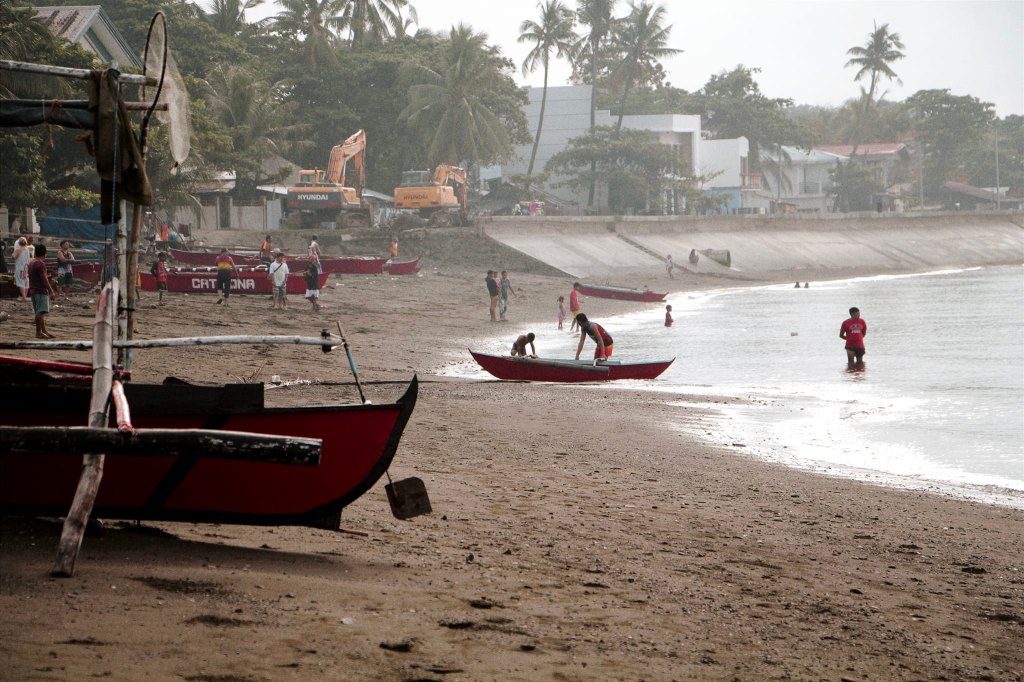
Photo by Franque Gilo/Facebook
History reminds us that communities rarely accept erasure passively. Each disruption becomes an opening to reimagine and rebuild.
“Ta puesto nalang ta. Para ma-brag ta nga naka experience ta nga wala ang seawall.” It might be a casual thing to say for the students of the University of the Philippines Visayas to comment on the widening of the town’s seawall but it elicits a deeper meaning cemented on both the structurality and subjectivity of what it means to be studying in the University. What do we do then, when bit by bit, sem by sem, LE after LE, these places will change? Altered in a way we cannot recognize anymore.
In the different nooks of Miag-ao, we have our signature spots with their designated purposes. Our non-negotiables where everything is shared. Where we’ve grown from the ceaseless hope of first year to the bittersweet aftertaste of fourth-year nostalgia.
Vineyard and Redtable.
Bangs and Puesto.
Lover’s Lane.
Baybay.
However, time is a prerequisite of change. A course everyone takes but has no definite target outcomes that could guide us towards an uno.
Suddenly, the perfectly timed rush of waves are overshadowed by the mechanical revving of backhoes. The stinging scent of salt was replaced with the putrid smell of fumes. What was then a horizon overheading is now demarcated not by the orange hues of afternoons but of the greyish undertones of steel in construction.
This brings confusion. An array of deliberative comments; conflicting suggestions; and a resonance destabilizing the “used to’s” and replacing it with “what do I do’s?”.
When our collective experiences become compromises for a system, when our collective experiences are reduced to compromises that serve a system that is not just profit driven but plundered by their contractors, senators, and project heads, what needs to be done?
We are again reminded that this small town is still part of that very system. Even if it has become the microcosm of analytics, activists, artists and scientists—all aiming to provide an avenue for the smallest whispers to the loudest of cries to be heard–is still overpowered by a silent mandate.
Time and time again, policies have been disguised. Even what it means to be an Iskolar is measured by bucket lists. By tasks checked in our 24-hour blocked google calendars and overdesigned notion pages to feel validated. The current education system is a factory for workers—incentivized wherein we are taught to survive not thrive. To compete because we are purposely given limited resources. To carefully count glass slides because we cannot afford accountability and buy another one. To keep our essays with a minimum number of words and cage our ideas with this limitation. To have our mothers in contact with loan sharks because there are not enough computers in TLRC. To be drenched in sweat after a hike because of the unavailability of dense student buses due to inaccessible student spaces. These inadequacies are only the tip of the iceberg in addressing the severity of studying the Philippines.
Likewise, subpar construction initiatives that put into the steeps public safety and intersectoral wellbeing while creating a deficit and depleting the public’s hard-earned taxes are never to be bragged about nor flood control systems that in reality serves invertedly. Our coasts with not only our livelihood, but of lush biodiversity must be protected—more so our taxes.
When this systemic modus operandus that disguise profit-driven policies as “for the people,” we cannot help but think that our collective interest is prioritized. But, this manipulation tactic erases not only our agency, but more so our identity–our ability to think, our purpose. We are put into hunger and starvation. Bit by bit, redirecting the system just right. Because a nation confused is a nation bare: their bones bulging, stomachs growling, and eyes dimmed and ready to close.
The roads and waters of the Philippines need no change–only the corrupt politicians who selfishly profit off from pretending they do.
What must be inked into posters are not DPWH funds but the 20 percent cuts made as it goes lower and lower the triangle.
Do we just stay put and enjoy late nights at the seawall or do we continue to grieve our lost shores? Do we have the responsibility to preserve and to fight for markers of heritages or do we ignore these changes and let it be uprooted along with our collective history?
It turns out that in order to be accountable, we also must be sensible. Sensible to stories of not just ours. We will always be a plurality of narratives and what makes us one is not only the places where we’ve had our first drinks; where we’ve experienced our first heartbreaks; where we left a half-empty coffee cold; or where dreams were first imagined. But it is the continual sensibility of being one with the Filipino people that connects us not only as Iskolars ng Bayan but also to the masses we bear responsibility to. We attach ourselves not only to places but to people. To memories. To struggle.
Replacing will not be synonymous to erasing our voices and minds and the statements we have rooted our struggles with—only if we remember.
Always, in all the ways Miag-ao can be traversed, there will always be you; an us—iskolars united by a bond that is knotted due to struggle; and tightened by a universal need for equity and liberation from constant oppression and repression.
Maybe erasing can also mean the resurfacing of what is underneath: the inefficiencies due to the opportunistic motives for the acquisition of power covered up by distortions and edifices.
History reminds us that communities rarely accept erasure passively. Each disruption becomes an opening to reimagine and rebuild.
Institutions may frame modernization as liberation—yet, in actuality, it serves more as a means of incapacitation. But even then, we have always found something to pour our confined energies into. We would always create something new to explicitly combat the system that cages us. Something tailored to our current realities. Specific. Inclusive. Non-invasive. Imaginative.
Every attempt to erase becomes proof of what cannot be destroyed—the will to adapt, endure, but to always remember.
The pricking by thousands of tiny pebbles might be replaced by the coldness of concrete with streetlights shining above; yet, what matters is the warmth adjacent to yours—a rhythm that steadies your uncontrolled heartbeats made by the certainty of uncertainties and continuity of probabilities.
Sheina Elijjah Penetrante is Pagbutlak’s features editor on its 51st year. She is a sophomore of BS in Public Health.

 Pagbutlak
Leave a comment