
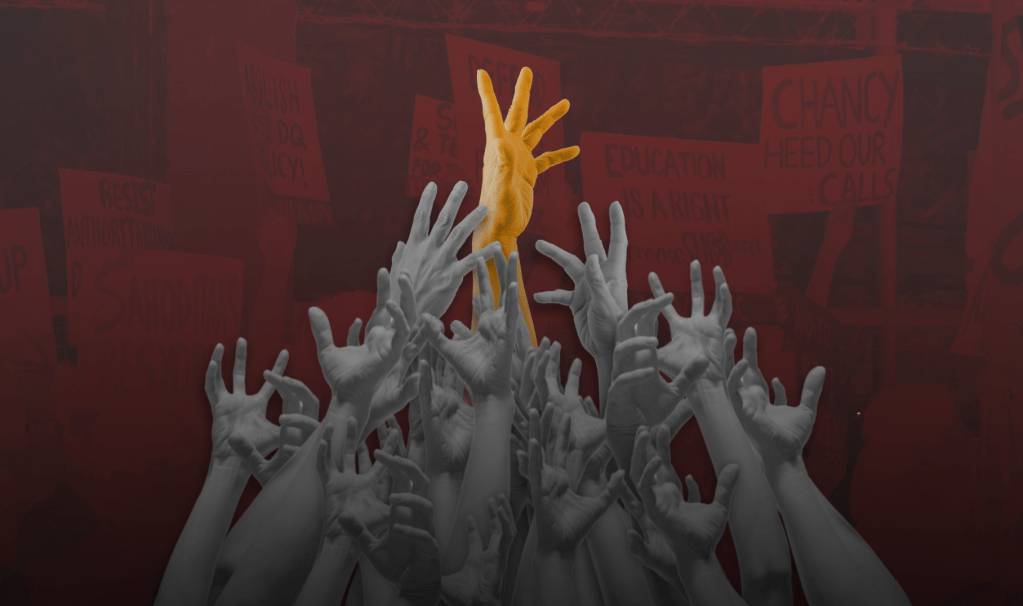
When you play the game of free education, you either win or risk being left behind. The middle ground often means having to pay for your education.
The promise of free education has always been a fragile dream for many Filipinos, where the odds were often stacked against them by the crushing burden of tuition fees. In 2017, this dream seemed closer to reality when Republic Act 10931, known as the Universal Access to Quality Tertiary Education Act or more colloquially as the “Free Tuition Law,” was signed into law. For many families, it felt like a long-awaited lifeline, a chance to break free from the financial chains and give their children the opportunity to pursue a dream that once felt too distant.
While the rules had changed, it remained just as unforgiving. In the end, not everyone would make it to the end, and for some, the stakes are still too high.
Many are called, few are chosen
Before its passage, access to free or subsidized education was available, but only to a fortunate few who managed to navigate the labyrinth of policies that kept many hopefuls at bay. Take the University of the Philippines (UP), for instance, which prides itself on welcoming students from all walks of life, especially those unable to fully pay the matriculation fees. We turn to the infamous Socialized Tuition and Financial Assistance Program (STFAP), which tied tuition rates to household income assessments.
STFAP was later replaced by the Socialized Tuition System (STS), which somewhat simplified the paperwork burden of its predecessor but ultimately retained the same bureaucratic complexities that made the process confusing and inaccessible for many. While these programs did indeed provide full-ride tertiary education to some students, they also placed others into a hierarchy that seemed to assign a price tag to their education—and their dreams.
The prospect of free tuition ignited a spark in many students. It is a chance to follow their passion without the looming dread of financial strain. However, they may have heard stories of the challenges that came with accessing this newfound opportunity, especially at prestigious institutions like UP.
The challenge was clear. Providing free education on paper was one thing, but making it accessible to all was another. It’s a high-stakes game where not everyone walks away a winner.
More players, limited space
State Universities and Colleges (SUCs), including UP, faced an overwhelming surge of students applying for admission, but the resources needed to accommodate them did not grow at the same pace. Many institutions soon found themselves struggling with overcrowded classrooms, insufficient facilities, and limited student services. As the number of students seeking free education grew, so did the strain on these schools.
UP offers a stark example. In 2023 alone, UP witnessed over 100,000 students taking its College Admission Test (UPCAT). Yet only around 15,000 slots were available, meaning a mere 15 out of every 100 applicants were accepted. The growing demand for spots has not been met with an increase in capacity, leaving many hopefuls, particularly those from lower-income backgrounds, facing the same uncertainties that existed before the Free Tuition Law.
Across the country, students applying to SUCs have voiced frustrations over limited slots and a competitive process that makes the dream of free education feel more like a gamble. Student applicants are left grappling with the reality that the promise of free education may not translate into tangible opportunities for all.
The House always wins
Adding to this challenge is the looming threat of budget cuts. The Department of Budget and Management (DBM) has approved a budget of P122.16 billion for SUCs in the 2025 National Expenditure Program (NEP), down from 2024’s P128.23 billion.
For UP alone, the proposed budget for 2025 would be slashed by P2.08 billion, the biggest in over a decade, a decrease that would cripple not only the university’s operational capacity but also its ability to support students financially and uphold academic standards. UP’s sprawling system includes multiple degree-granting units, research facilities, teaching hospitals, and specialized campuses across Diliman, Manila, Los Baños, Visayas, Mindanao, Baguio, Cebu, and the Open University.
The challenges do not stop there. Affordability becomes subjective when it is compounded by the rising cost of living, making it increasingly difficult for families to support their children’s education. For many, the cost of lodging, transportation, and daily necessities adds layers of financial stress that are not directly alleviated by the tuition fees waiver alone.
Rewriting the rules, redefining the playing field
The conversation around this issue is ongoing and often heated, especially during times when topics like the ‘UP Burgis’ controversy dominate public discourse. However, addressing the scarcity of free education requires more than rhetoric. The state’s constitutional mandate to prioritize education must be backed by sustained investment and comprehensive changes, amidst the worsening learning crisis.
At the heart of this struggle is a simple truth: without continued investment, free education remains an illusion for many. The danger of repeating history, where only a select few benefit while the majority are left behind, is very real.
And in this game of chance, the house always wins unless the system is rebuilt to serve everyone.
The endgame: will ‘free education’ truly be free?
As the country looks ahead, the question remains: will the promise of free education hold? It is imperative that we continue to advocate to ensure that the dream of being a true “Iskolar ng Bayan” is not just a distant aspiration but a reachable reality for all. Ultimately, the promise of free education is at risk of becoming just that—a promise.
Until the rules are rewritten, the harsh truth is that when you play the game of free education, you either win or risk being left behind. The middle ground often means having to pay for your education.
It’s not just about increasing admission slots, it’s about building classrooms, upgrading facilities, hiring more faculty, and expanding student support services to create an environment where every student can thrive. Policymakers must also rethink financial assistance programs to consider the hidden costs that disrupt access to a truly free education.

Phil Liam Nono is a sophomore statistics student at the Department of Physical Sciences and Mathematics. He is a senior news writer for Pagbutlak.


 Pagbutlak
Leave a comment