
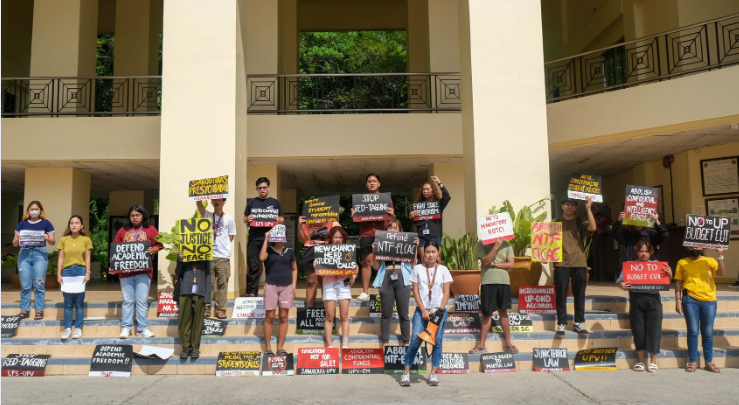
Our collective outcry proves the objectivity of these “complaints,” pushing us to work hard for our cause.
Having spent nine semesters at UP Visayas (four of which under online classes, five face-to-face, and all nine spent under Camposano’s two consecutive terms), having been both a stellar student with UNOs filling my CRS account and now a student unable to finish my units in the usual four-year timeframe, and having been an organization member and a student leader in our university’s councils, I think my long and colorful stay at the university lends itself well for the task of grading the institution. Yes, against the uno, dos, tres, kwatro, and singko grading system we’re all familiar with.
There’s no language that bridges the divide between students, faculty, and administration better than the universal tongue of the grading system, if to settle the inevitable divide in our semantics and registers, and if to reach conclusions that make sense to all.
Projects
The administration, much like a diligent student, knows how to highlight its accomplishments and makes sure we’re aware of them. You’ll frequently see posts on UPV’s official page about its achievements: higher rankings, new capacity-building initiatives, research projects, and partnerships with diverse partners. These announcements are usually accompanied by sleek, eye-catching publication materials, featuring the signature “certificate-handoff-and-handshake” photos, with our beloved school administrators smiling widely.
Sometimes, these celebratory posts can also be found in our Chancellor’s Facebook account. And if you’re really lucky, you might even catch a lesson or two from Dr. Camposano through his social media musings on Bourdieu or Goffman, applying theoretical frameworks to our current but oddly specific situations.
UP Visayas certainly knows how to broaden its horizons and work with a diverse range of partners, regardless of their background. It’s so welcoming, in fact, that it even opened its doors to the RTF-ELCAC, a notorious red-tagging task force that has been endangering students and educators for years since its formation, complete with a tour back in November 2021. This was supposed to be a testament to the university’s commitment in welcoming “plurality and diversity.” Now we’re left to wonder who else it is willing to shake hands with.
Participation, collaboration, synthesizing ideas, and group works
As someone who has worn multiple hats – an organization member, activist, and two-time student council officer – I can acknowledge that the administration, particularly the OVCAA, OVCA, and the Office of the Chancellor, has generally been supportive of student-led initiatives. I can’t recall any event that was outright denied unless there were clear logistical constraints. And to his credit, Chancellor Camposano, despite his diverging political views, often emphasizes his commitment to respecting the “plurality of ideas” he has preached since his first bid for the chancellorship. So regardless of the nature of our events and his politics, he and the offices under him do place that coveted stamp of approval.
Once, I recall sitting in the cold, imposing office of the Chancellor last year as the UPV USC’s People’s Rights and Welfare Head alongside my co-officers. It was for a dialogue on student demands. And yes, they were “demands,” a term which Camposano found too abrasive for his liking. But the real shocker came when he dismissed our request to support our initiatives against Charter Change and the Jeepney Phaseout, deeming it “intellectually dishonest” to oppose these policies when in fact he supports them. His argument? That it’s “about time” for change — in the constitution, for modernization, for progress.
I would have engaged in a productive intellectual tussle as, for one, the matter of opposing the Charter Change is about the type of Charter Change being pursued, and second, the Jeepney Phaseout will quite literally massacre our drivers’ and small-scale operators’ franchises. But I did not have the bravado then, nor the mental preparation, nor the specific philosophical thinker or author to cite for that specific exchange.
Timeliness in outputs
I made mention that the higher offices do approve any sensible and well-planned event for students, but it takes so much time and struggle, I don’t think they even realize it. I do have in mind my thankfulness towards the Office of Student Affairs (OSA) and Student Organizations and Activities (SOA) who tirelessly and patiently sift through student paperwork to ensure that everyone is compliant with a freaking alphabet soup of requirements just to hold a single event in school and use its venues, which are meant to be for the students, by the way: letters, permits, requests, forms, waivers, Student Participation Agreements, conformes, curriculum vitae for speakers, etc. – you get it.
Commit one mistake in this process, or encounter an unknown required form, and you’ll find yourself back to square one, leaving your event in limbo. This bureaucracy often leads to delays or cancellations, hurting organizations already struggling to sustain their activities. It’s especially disheartening for sociopolitical and mass orgs trying to push campaigns. Many student organizations, while juggling academic pressures, also have to fight hard to run their events, initiatives, recognition, and support efforts, particularly those in talent, arts, and competitions.
Outputs: Conditions for learning in the institution
Part of the work at the National Students’ Day Working Committee, a newly formed alliance for the National Students’ Day 2024, is consolidating grievances from the students through the basic units of organizations so we may strategize the best action to take, recognizing that our previous ones barely worked. We’ve done this through 3-4 consultations, and what we uncovered reflects the harsh reality of pursuing an education here. We’re caught in a cycle of fighting for meaningful improvements, yet those changes have been incremental at best, considering the extent of what’s needed.
Despite small improvements, the challenges remain significant: high costs for fieldwork and thesis projects, inadequate facilities, unsafe classrooms (especially in SOTECH), unreliable campus Wi-Fi, limited mental health support, unsupported athletes and talents, and burdensome bureaucracy. Students also face delays in class dismissals during calamities, adding unnecessary risks, while appeals for leniency are often dismissed. The removal of reading breaks went unconsulted, and now we have strong data from the UPV USC indicating the students’ need for one.
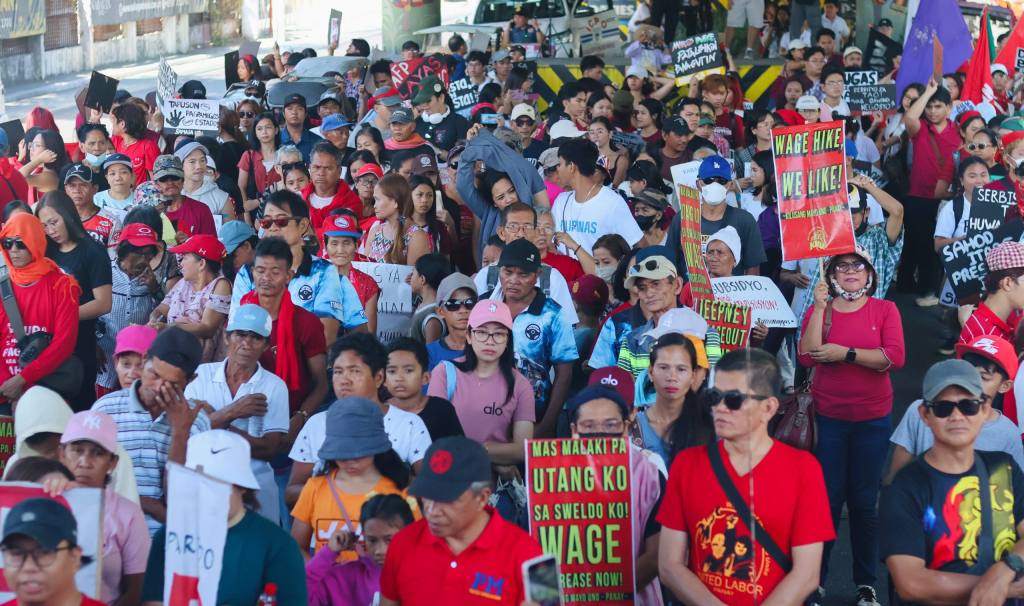
Earlier, I mentioned bravado — and I’ll admit, I wouldn’t have the bravery and the sure-footedness to write this or be among the forces organizing the NSD Walkout on November 15th, if not for the students voicing their frustrations. Our collective outcry proves the objectivity of these “complaints,” pushing us to work hard for our cause. In fact, the past week for NSD has been inspiring. We’re drawing strength from each other and making the most of our resources to fight for each other’s welfare and become the forces and numbers behind student councils who, recently, have been questioned on whether they truly represent the students’ interests.
What’s the grade?
With all these assessments, I give the UPV Administration a generous 4.00. It’s done enough to show up and be present. A 5.00 would mean it’s never there at all, or that it outrightly bastardizes its functions and blatantly oppresses its students, which is truthfully not the case. In the academic parlance, it pushes for quality education and insists on academic freedom, and does not suppress at least most of its student-led events and initiatives.
However, a 4.00 also means we’re desperate for more: more for ourselves as we pursue education, and for the conditions of our educators who are also affected. Ideally, we need something to make an objective case for that sweet “final grade”.
It’s late in the semester, and perhaps at this unfortunate point, that “something else” we need to see is the administration’s response to the NSD 2024 Student Walkout; our clear message that while there are times to pursue our education to the best of our abilities, there are also times we must stand up and insist that our conditions are no longer enabling us to do so, and that we won’t tolerate it any longer. We’ve already had enough.
It’s not too late, though! A 4.00 can be turned into a passing 3.00 or a failing 5.00.
In any case, don’t expect a Latin Honor.
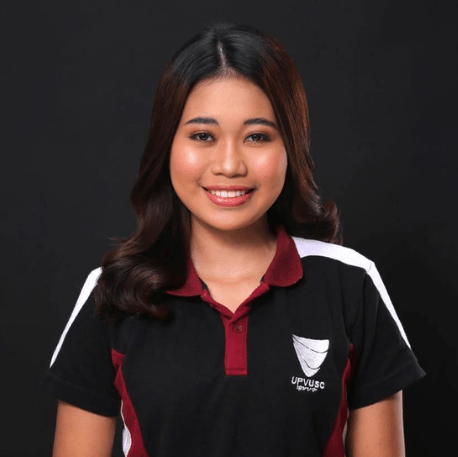
Ciania Belle Gloria is in her senior year as a BA in Political Science student at University of the Philippines Visayas. She was Secretary-General of the UPV CAS SC in 2022-2023, and the PRAW Head of the UPV USC in 2023-2024. Currently, she is the Point Person of the National Students’ Day Working Committee in the same university.


 Pagbutlak
Leave a comment