
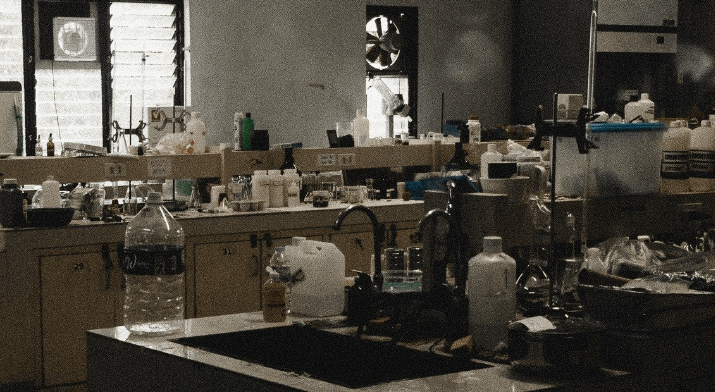
Long-standing issues like budget cuts and the lack of administrative intervention to support our campaigns for quality laboratory facilities remain a sight too far from us to see.
It’s Monday again.
As usual, early morning hours are spent sitting in lecture classes and we’re back in the game as academic weapons in action. The grind begins anew, and for many of us, it is a relentless march through the halls of a broken system (and lab equipment, too). However, don’t be surprised if you ask me about my loveli–I mean, lab life–as one merely treading beyond “rainbows and sunshines.”
For a Biology student like me, stepping into laboratory classrooms almost everyday is part of the routine. Whether it’s inhaling both harmless and toxic chemicals or deciphering intriguing Latin and Greek names all taped to specimens–some neatly arranged, others chaotically scattered in the white corners of the room–it’s all just another day. But let us not confine the concept of “laboratory” to the realms of the Biological Sciences (BioSci) and Chemistry Department. Any room designed to provide the right conditions for conducting experiments or measurements can be considered a lab–but that’s precisely where the problem begins.
The world of laboratory classrooms, even for those studying fundamentals, I suppose, is a world of wonder. I, for one, am a lab person— experiments and dissections become my thing, and laboratory reports? They’re my daily bread (sometimes tasty, sometimes bland). To me, a laboratory classroom is a home; to others, it might feel like an entirely different world.
However, it’s hard to call it a home, or even a wonder when Mondays greet you with poorly ventilated and tightly-spaced laboratory rooms, expired reagents, and crumbling walls that whisper tales and neglect. Even worse, the grind doesn’t stop there when you have back-to-back lab sessions until Friday. One thing you need to do is just brave through room after room, sometimes at the cost of the quality of our work in the process.
The most glaring problem? Our laboratories are falling apart. One thing that is evident in almost all laboratory classrooms is the deteriorating infrastructure especially that the building has literally stood the test of time and now boast dilapidated ceilings and cabinets threaten to break free from their hinges. Minor cracks and peeling paint mar the walls, threatening further damage if left unattended. Safety is compromised, and we are left to gamble with our wellbeing.
Moreover, ventilation–or the lack thereof–is also not giving in some energy to some of the laboratory classrooms, particularly in basement laboratory classrooms. This isn’t just a comfort issue; it is a significant problem when it comes to biosafety tasks, such as microbiological experiments. In these conditions, precision is impossible. Results are compromised. Time and resources are wasted. Yet, despite these glaring issues, we’re expected to churn out excellence.
On top of this, budget cuts remain a pressing issue when it comes to laboratory classrooms. They aren’t just abstract numbers; they manifest in our daily struggles. From my experience, its impact is palpable, particularly in the quality and quantity of our equipment. We perform dissection experiments in the poorly ventilated Zoo Shed, carry out streaking procedures with broken glass spreaders, and attempt to extract macromolecules using expired organic solvents, often yielding little to no results.
But let’s be clear: we cannot place the burden and blame on our instructors and professors, who go above and beyond to ensure we produce decent outputs despite these challenges. They, too, are acutely aware of the problem. The real culprit is the persistent, oppressive system that underfunds education, depriving us of our basic right to safe and conducive laboratory spaces. Long-standing issues like budget cuts and the lack of administrative intervention to support our campaigns for quality laboratory facilities remain a sight too far from us to see.
Even with the administration’ grand plans for a new CAS Building within the university, the laboratory classrooms that remain must be prioritized for repair, maintenance, and regular monitoring. If we truly aim to cement our status as the premier university in Western Visayas and the country, we cannot afford to let these facilities fall into disrepair. Things will go down in shambles if we cannot mobilize our resources better, especially that these rooms continually birth some of the future scientists of the nation. To neglect these spaces is to sabotage our potentials.
The admin must mobilize its resources strategically, because if they fail to address these urgent issues, our status as a premier institution will crumble.
This is my lab life. Our lab life.
Anyway, it’s Monday again—time to gear up for another week of fighting a system that seems designed to break us. But rest assured, we will not back down.

Vladimir Amadeus Mercado is a senior of BS Biology in the Division of Biological Sciences. He is a senior column writer for Pagbutlak and the holdover Associate Editor since 2021.




 Pagbutlak
Leave a comment