
Balbon slammed the government’s inadequate response to these issues, noting that instead of providing necessary subsidies, the state has intensified civil-military operations, imposed curfews, and engaged in red-tagging of progressive groups.
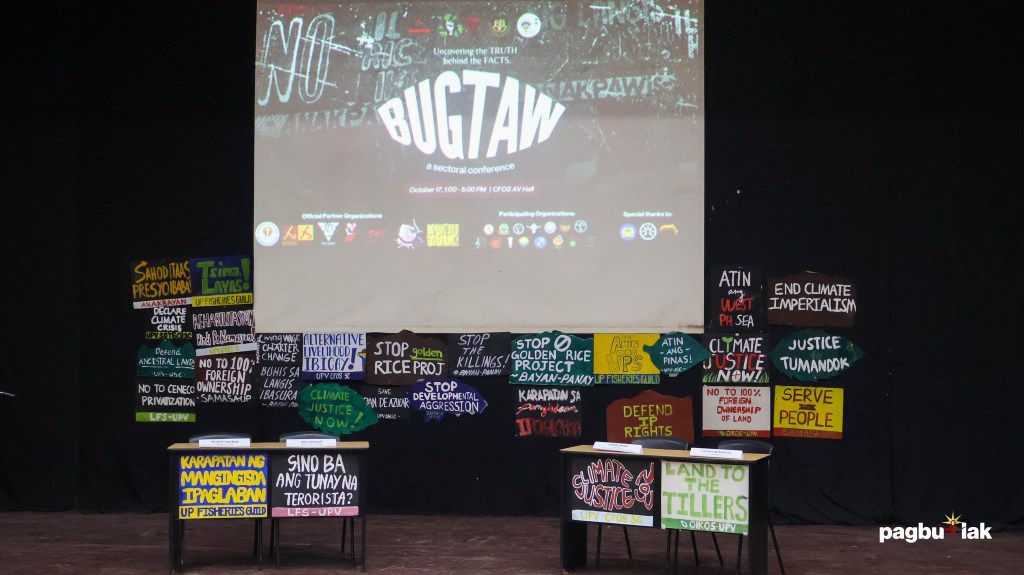
MIAGAO, ILOILO — Amidst rising military presence in rural areas, students and sectoral representatives gathered at the CFOS AV Hall, UP Visayas Miagao Campus, for the annual BUGTAW: A Sectoral Conference on October 17. The event, part of the UP Visayas University Student Council’s observance of this year’s Peasant Month, aimed to address the pressing issues faced by peasants and Indigenous communities.
The conference featured a lineup of speakers, including Prof. Elmer Jover from the Division of Social Sciences, Arlie Bosque of the Defend Panay Network and Kabataan Partylist, Melbert Balbon, spokesperson for Pambansang Lakas ng Kilusang Mamamalakaya ng Pilipinas – Panay (PAMALAKAYA-Panay), and Lucia Capaducio, Chairperson of Paghugpong sang Mangunguma sa Panay kag Guimaras (PAMANGGAS).
In his address, Professor Jover lambasted the Anti-Terrorism Law of 2020, arguing that it has been weaponized to suppress dissent, instilling fear and disunity rather than ensuring security. He condemned Executive Order 70’s “whole-of-nation approach,” labeling it a “whole-of-government bureaucracy” that fails to involve the public effectively.
Jover highlighted the militarization of rural areas and the weaponization of laws against peasant groups, referencing the 2018 Memorandum Order 32, which increased military presence in Negros under the guise of anti-drug operations. This initiative led to the Guihulngan Massacre and other killings on the island.
Echoing these concerns, Arlie Bosque focused on the impact of militarization on the Tumandok Indigenous communities in Panay. He pointed to the Jalaur Mega Dam Project as a significant threat, resulting in land loss, environmental destruction, and disrupted livelihoods while escalating military presence that restricts cultural practices of the IPs.
Bosque reprehended the Tumandok 9 massacre and emphasized that similar assaults on Indigenous Peoples (IP) communities have been reported, highlighting a broader trend of violence.
“Dapat nating i-recognize na kayang iligtas ng mga Tumandok ang sarili nila, but the most we can do is join their campaigns and expose the issues they face. In this way, we can help them win their fight,” Bosque urged.
Melbert Balbon addressed the challenges faced by fisherfolk, revealing the effects of fishing restrictions. He explained that low catch rates from the southwest monsoon and the Visayan Sea fishing ban make it difficult for them to sustain their livelihoods.
Balbon slammed the government’s inadequate response to these issues, noting that instead of providing necessary subsidies, the state has intensified civil-military operations, imposed curfews, and engaged in red-tagging of progressive groups.
Furthermore, he cited a recent alert from PAMALAKAYA-Panay regarding the profiling and intrusion of the Armed Forces of the Philippines (AFP) targeting fishers in Barotac Nuevo, Iloilo.
Lucia Capaducio also denounced the CMOs for their intimidation tactics that disrupt farmers’ routines. She underscored that towns such as Igbaras, Miagao, Janiuay, and Capiz—where mass movements of farmers are active—are subjected to aggressive military operations, further marginalizing those already vulnerable.
During the concluding open forum, Capaducio and Balbon emphasized the stark disparity in living conditions between different communities, noting that while some enjoy full meals, farmers and fisherfolk struggle daily to make ends meet while facing the added threat of being targeted by state forces for their activism.
The panel collectively called for the repeal of the Anti-Terror Law and the National Task Force to End Local Communist Armed Conflict (NTF-ELCAC), asserting that these measures are often weaponized by the state to suppress dissent among peasant workers.
The conference highlighted the urgent need for solidarity and action to combat the militarization of rural areas and protect the rights of farmers and Indigenous peoples.

Phil Liam Nono is a sophomore statistics student at the Department of Physical Sciences and Mathematics. He is a senior news writer for Pagbutlak.



 Pagbutlak
Leave a comment