
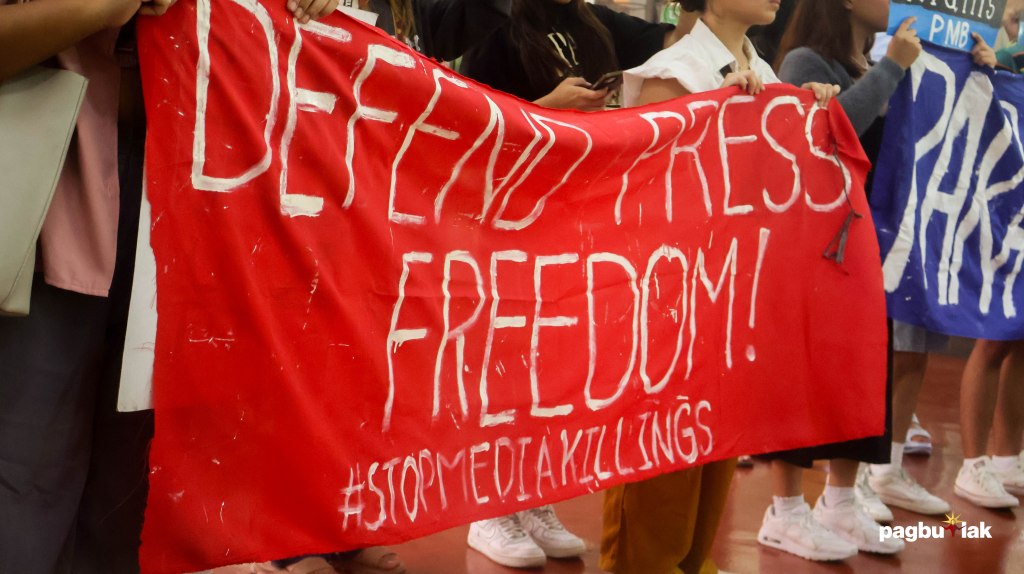
Press freedom does not exist in a nation that silences its citizens. Today, August 30, we celebrate National Press Freedom Day for the third year since its declaration in 2022. Yet, funny enough, the Philippines remains one of the deadliest countries for journalists, ranking 116th out of 180 in the Press Freedom Index for 2025.
How fittingly hypocritical that former President Rodrigo Duterte declared this holiday while presiding over one of the fiercest assaults on media freedom. Yet, this government refuses to acknowledge the importance of the Campus Press Freedom Bill or the lives lost in the fight for truth—turning this “celebration” into nothing more than an empty grand gesture, stripped of any worthy substance.
For so long, Filipino journalists have stood at the center of every revolution. Change, either documented or written, was fought with pen and paper. The press represents critical thinkers, those whose minds question power and systems. From our heroes of the past to our modern reporters who exposed corruption, injustice, and incompetence—the media has played a key role in the checking of power. The existence of National Press Freedom Day reflects that very distinction. However, this mighty power of the pen does not come without its sufferings.
Marcelo H. del Pillar, the “Father of Philippine Journalism”, wielded La Solidaridad against Spanish colonial rule. More than a century later, to be a Del Pilar in this country is no badge of honor—it is a death sentence. His sacrifices directly mimic those that our modern-day writers face today. Where he once faced exile, today’s journalists face red-tagging, false accusations, and bullets. To be a writer in the Philippines is to not only inherit Del Pilar’s struggle, but also his suffering.
A Del Pilar of our time is being shot, intimidated, or harassed in every way possible. Writing critically about the government lands you in prison, as in the case of Tacloban-based community journalist Frenchie Mae Cumpio. A Del Pilar of today is not remembered in history books but buried under headlines. Shot on the street, jailed, silenced by fear. Cumpio is a living echo of Del Pilar, revealing that the fight for press freedom has never ended but only evolved into new forms of repression.
This is why being a journalist in a nation that equates peace with sterile silence and the stifling of voices is a grim fate: you are forced to choose between your morals or your life. And in this scenario, silence becomes too tempting.
Maybe that is exactly what they want: to mute, to hush, to suppress ideals that ruin theirs. Then, like laying flowers on graves they themselves dug, they cover up their crimes through a declaration of a hollow holiday that barely honors what it stands for—thinking it would somehow justify the violence. The state would like us to believe that August 30 is a day of pride. But to journalists, it is a reminder of what it costs to keep the truth alive. It is in this wretched hypocrisy and dishonesty that those in power seem to forget: Filipino journalists have always been at the forefront of every revolutionary change. The people and the media are in power, not them. Freedom, after all, is not granted by proclamation. It is claimed through resistance.
They have tried to control us, restrain our voices, and dry our pens. Yet, freedom has never been theirs to keep. Freedom exists within the ink-stained hands of writers, the sore-throated reporters, and the starving truth-seekers. They do not have the power to hold our freedom within the grasp of their greedy palms and their golden gates. Rather, these are merely obstacles we must overcome to hold the truth in its rightful place.
So, speak. Shout. Yell. Refuse the silence. There is no freedom in a nation that mutes its citizens—but it has always been and will always be within reach. Standing at the frontlines, the press will make it so by continuing to hold the pen and the megaphone, bringing forth the voice of a country that refuses to fall.
Today is not a holiday for mere commemoration. It is not for the sake of remembering alone. Now more than ever, we must demand that the words press freedom become more than just a symbolic charade, but a lived experience for every Filipino, every day.

 Pagbutlak
Leave a comment