
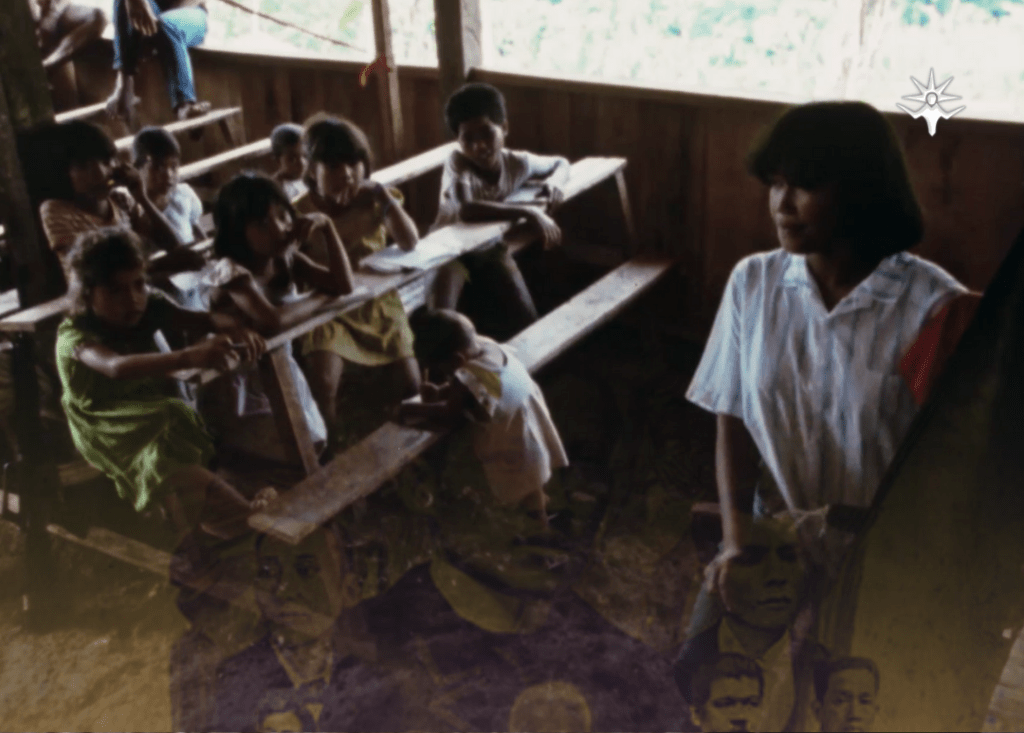
“In the people’s need for land and desire to control their own lives lies a revolution.”
It begins quietly. A rustle, something subtle enough to overlook. Yet what rustles in Nettie Wild’s A Rustling of Leaves: Inside the Philippine Revolution (1988) is not simply foliage in the forests where guerrillas hide, but revolution and history itself, tangled in the turmoil of hope, oppositions, and terrible violence in the turbulent heart of post-Marcos Sr. Philippines.
Every year we bow to stone statues of heroes who once unsettled the status quo. Yet, Wild confronts us with a harder truth. Yesterday’s heroes were once branded disruptors, just as today’s revolutionaries are still cast in the same light.
The film dismantles the illusion that history is a settled account. Instead, it shows that the fiercest battle is not only on the ground but over narrative—over who gets to be remembered as hero and who is condemned as enemy. Red-tagging, impunity, and violence are deployed not just to silence dissent but to reshape the story itself: who is victim, who is criminal, who is hero.
Wild first places us inside a historical moment defined not by resolution but by contradiction. In one telling cut, Cory Aquino’s boast that the Philippines will be “one of the greatest countries in the world”, is followed by a garbage dumpsite, with people from the slums scavenging for money and purpose in a place laden with waste. Aquino, celebrated for “restored democracy”, presided over the 1987 Mendiola Massacre, where nearly 10,000 farmers demanding land were met with state gunfire.
All of the symbolic weight of Cory Aquino’s presidency crumbles as this violence under her watch makes it evident that state and military brutality did not die with the dictator but simply changed color and uniforms. The Marcos dictatorship has fallen, but the underlying social dilemmas, the oppressive Western imperialist entanglements, class hierarchies, and land inequity remained.
Elsewhere in the film, we meet the paramilitary vigilantes—Jun Pala’s “Alsa Masa” and Bato dela Rosa’s “Tad-tad”—central figures who stand brazenly in their merciless acts of terror and violence against those they brand as “communists”, speaking of killing with a grin as if it were amusement. Their casual cruelty, raw and unfiltered, prefigures the brutalities decades later in the Duterte administration. These admissions show a cycle of impunity stretching from Marcos through Aquino and beyond. The violence here is not hidden; it is performed. It is boasted of.
As layers of stories are laid bare, one realizes that rather than a static chronicle, this film is a work of political clairvoyance, anticipating today’s historical distortion and unending battle for narrative as the same patterns of inequality and repression rebrand over and over again. Scenes of common Filipino people confronting tanks and armed soldiers contextualize the notion that the revolution is not an abstract belief system but as an everyday uprising for survival.
The patterns are painfully familiar today. Dee “Ka Dahlia” Supelanas, a trans woman activist and UP Cebu alumna, was among seven killed in Kabankalan this year. In 2022, volunteer Lumad school teacher and environmental activist Chad Booc was slain in Davao de Oro after the military claimed he died in an encounter—despite witnesses and colleagues insisting he was targeted for his work with indigenous communities. In 2020, UP Visayas alumnus Malvin “Ka Lean” Cruz was killed in Miagao, his life dismissed as “wasted.”
What connects these names and places is not only grief but distortion. Power ensures that activists are remembered not as defenders but as casualties of a “false revolution”, their humanity effaced by the labels imposed upon them.
“Democracy must have as many colors as the rainbow; and there is no rainbow without red,” Ed Dela Torre says in the film. However, the state insists on erasing red entirely. By casting activists as terrorists and communists, by silencing humanitarian laborers, and by revising textbooks to glorify Martial Law, power wins not only through artillery but through stories. This can be seen in Cagayan de Oro earlier this year, when posters red-tagging progressive party-list nominees Kabataan, Bayan Muna, and the Alliance of Health Workers to the CPP-NPA-NDF suddenly appeared. This tactic is recycled from the 1980s and is continuously being utilized in subsequent years.
The rustling of leaves, then, evokes something so faint that it can be easily unnoticed. Yet the rustling here symbolizes something deeper: the movement in the undergrounds, the unrest that trembles even the most rooted foundations. Wild invites us to listen closely to these small sounds and to recognize that revolutions do not erupt fully formed but are born of accumulated grievances, ignored clamors, and unseen labor. It insists that heroism does not begin at monuments. It begins in the refusal to be invisible, in the courage to resist silence, in the daily struggle for land, bread, and dignity.
This is the disquieting truth we face. The very acts of defiance that once defined the making of this nation are now recast as threats. The same cries for land and dignity that were once celebrated as patriotic and heroic are today answered with bullets and erasures.
A Rustling of Leaves is both a documentary and a prophecy in hindsight on how revolutions die and rebirth everyday and everywhere—in military crackdowns, media narratives, bullets fired on forests and bridges, people’s hunger, and in the quiet decisions of individuals confined by larger and more powerful forces. Wild knows that all of these are not separate narratives but are interconnected and breathing within the same ecosystem of struggle. With this, the truth is revealed which is more disturbing than the ceaseless occurrence of inequality and injustice: that this injustice never dies but evolves, transforms, and reshapes itself beneath the changing banners of new leaders and hollow promises.
Inside this revolution, Nettie Wild found not only stories but a mirror, reflecting the Philippines and, perhaps, any nation caught in the never-ending cycle of violence and forgetting. Over thirty years later, its echoes have only intensified.
The leaves still rustle. The struggle continues. And so does the battle for narrative in a country that erases.




 Pagbutlak
Leave a comment