
or malacademia at UP Visayas
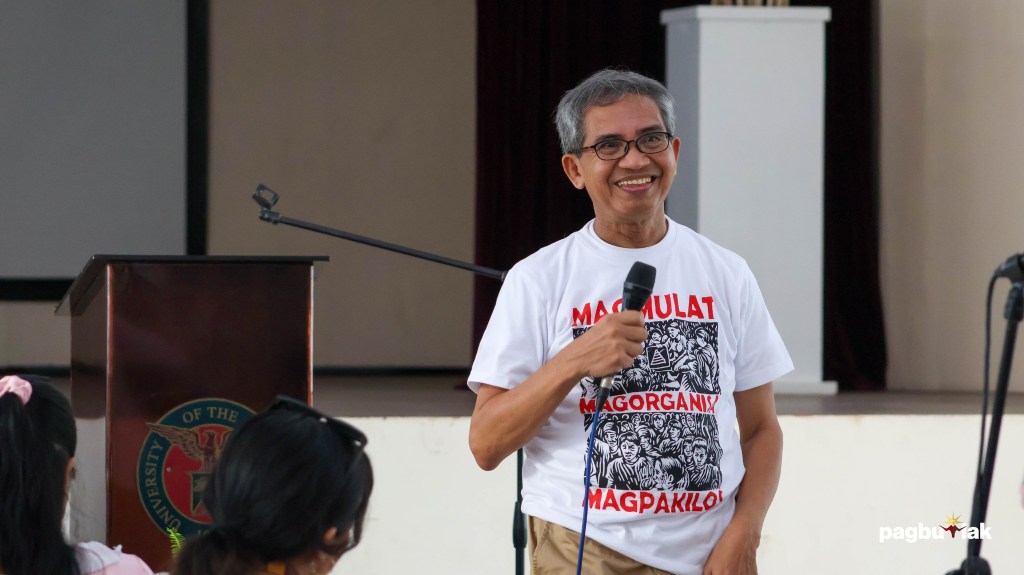
This essay was delivered as Prof. Tomasito Talledo’s retirement lecture at the UPV Little Theater, UPV Iloilo City Campus on December 6, 2023
First Part | Tales of Mirrors: Those Lies That Convey Truth
I am more fascinated with the telling of fantastic tales; I am enamored with tales that fired imaginations rather than of clinical and cold expositions and conclusions. Playing long the role of a facilitator in the heavy traffic of outrageous ideas, out-of-place opinions, and naughty stupidities inside the classroom for almost four decades in the University, I observed that what grip the attention of learners are fascinating tales or are extraordinary stories. I have not fully grasped the reason why, but I suspect this attentiveness is an aspect of our human penchant in the collective psyche of our ancestors who long ago gathered around the warmth of fire to listen to tales. Luckily, we inherited such attentiveness.
In my experience as one who handled General Education (GE) subjects, the teaching and learning moments commence at the beginning of an unexpected story, that is, when teachers and learners are surprised and found joy in rapt attention. What is GE after all if not an adventure of imagination into unfamiliar space and time sans the agonizing burden of the “logy” (or the focus object of study)? I found the nature of our GE courses in the University as more idiographic than nomothetic, not that scientific but more of poetics, less absolutely stated but more intuitively hinted.
Indulge me now with your patience while I try to unpack the nature of our GE courses as I share The Three Tales of Mirrors in this Lecture. These tales serve as sort of a carrying vessel that I prepared for us to cross the treacherous river of meaning-making and stock-taking. These stories are our metaphorical ferry of Kharon, the boatman who brings woeful souls to their deserved location.
First Story | Source: “The Broken Mirror” from the Snow Queen Tales collected by Hans Christian Andersen
Once upon a time there was a troll, the evilest troll of them all; he was called the devil. One day he was particularly pleased with himself, for he had invented a mirror which has strange power of being able to make anything good or beautiful that it reflected appear horrid; and all that was evil and worthless seem attractive and worthwhile. The most beautiful landscape looked like spinach; and the kindest and most honorable people looked repulsive or ridiculous.
“It’s a very amusing mirror,” said the devil. But the most amusing part of it all was if a good or a kind thought passed through anyone’s mind the most horrible grin would appear on the face of the mirror. It was so entertaining that the devil himself laughed out loud. All the little trolls who went to the troll school, where the devil was headmaster, said that a miracle had taken place. Now for the first time one could see what humanity and the world really looked like.
At last, they decided to fly up to heaven to poke fun of the angels and God Himself. All together they carried the mirror and flew up higher and higher. The nearer they came to heaven, the harder the mirror laughed, so that the trolls could hardly hold onto it; still, they flew higher and higher: upward toward God and the angels, then the mirror shook so violently from laughter that they lost their grasp; it fell and broke into hundreds of millions of billions and some odd pieces.
Some of the splinters were as tiny as grains of sand and just as light, so that they were spread by the winds all over the world. When a sliver like that entered someone’s eye it stayed there; and the person, forever after, would see the world distorted, and only be able to see the faults, and not the virtues, of everyone around her, since even the tiniest fragment contained all the evil qualities of the whole mirror. If a splinter enters someone’s heart—oh, that was the most terrible of all—that heart would turn to ice!
I am amazed of this story from Andersen’s Russian religious tales since it alerts me of the strong inclination to consider knowledge earned in the University as some sort of capital investment with expected fat returns in the future. I also came to observe that learners and teachers seem obsessed with accumulation and preparation for some safe future career thus sidelined the surprising joy of living precariously, nay, dangerously. Why, had we not heard the saying that “the secret of greatest enjoyment from life is to live dangerously” by Friedrich Nietzche? Aversion to risks, fear of failures, avoiding the road less traveled is the loudest whisper we heard. It was and is the hidden module before, during and after pandemic. Not only the loudest whisper but the pernicious fragments of that broken mirror lodged in the eyes of the many including myself. Thus, appearances were inverted as in camera obscura and had us perceiving the good or beautiful as horrid or terrible. Now in our current academic culture, excellence is equated with collected certificates of recognition and honor is equated with capturing the top rank, while the unhurried and quiet contemplation is considered as failure of indolence.
Second Story | Source: “The Mirror of Erised” from Sorcerer’s Stone by J.K. Rowling in Shawn E. Klein’s “The Mirror of Erised: Why We Should Heed Dumbledore’s Warning”
The boy character Harry Potter accidentally discovers the Mirror of Erised in an unused classroom at Hogwarts. He notices the Mirror’s odd inscription: “Erised stra ehru oyt ube cafru oyt on wohsi.” [Trans. “I show not your face but your heart’s desire.”] This is no ordinary mirror — a little surprise in a world where cars can fly, and portraits talk. When Harry looks into it, he does not see his own reflection, but instead the images of his dead mother and father smiling back at him, even waving. He immediately looks around the room, but his parents are not there; they are only in the Mirror.
The schoolmaster Dumbledore reveals to Harry what the powers of the Mirror of Erised are: “This mirror will give us neither knowledge nor truth. Men have wasted away before it, entranced by what they have seen, or been driven mad, not knowing if what it shows is real or even possible.” He goes on to warn Harry that “it doesn’t do to dwell in dreams and forget to live.” While we might be able to learn something from looking in the Mirror — perhaps something important and shocking — we cannot pursue or satisfy our worthwhile desires in the Mirror.
Still the Mirror does offer us one truth — it shows us what we deeply and desperately desire. While our lives should not be spent just in desire-satisfaction — as the Mirror of Erised illustrates for us — we do have desires that are worthwhile to pursue and satisfy. The desire for self-improvement and for non-oppressive happy relationships is also a significant part of life.
The pivot of the story lies in understanding the palindrome, that is, a phrase that reads the same backward as forward as a model of reference. Often than not when learner and teacher meet for their regular class session, both soon tumbled into swirl of the banal, the taken-for-granted encounter with boring everydayness of life. The regular rhythm of the routine, those predictable interpersonal relations in the academe, and the placid state of our salary account in the Land Bank became the Mirror of Erised. As mirror it does not reflect that we are disagreeable examples to others but shows instead our desire as likeable creatures in the University. Again “this mirror gives us neither knowledge nor truth.” More likely knowledge and truth as learner and teacher lie outside the construction of ourselves in the everyday life because everyday life is the deathbed of our passions. And my fear is glancing at our joie de vivre, the exuberant life of our mind is already attached to a monitoring device inside an Intensive Care Unit (ICU). Passion dies when honest audacity is wickedly discouraged but slavish obeisance is rewarded. Passion dies in the mad pursuit of high metrics of performance. Passion dies when recognitions and positions granted presume the acquisition of wisdom.
Third Story | Source: “Place without Mirrors” by Tomas Talledo from Songs of War Patriots and other poems
In a faraway place, so far you can imagine, farther than imagination, there are no mirrors.
There are no mirrors in this place though people had been laboring to have one. Though extraordinary artistry was resorted to, but no mirror or its equivalent was ever produced. Not even shiny metals, crystals, clear water not wood reflect the images of people. No object can report back what faces of people look like. Everyone has invisible reflection.
This is the place without mirrors.
All hopes not lost though because one can see herself but not her reflection in the eyes of another person.
In unprepared way, only in unconscious moment one can have a glimpse of oneself in the pupils of another person’s eyes. But so many do not like this moment, in fact, nearly all hate this revealing chance.
And they refused to talk about it to anyone. A few were brave enough to report what they saw in another person’s eyes. But what they saw, they say in bits and parts of words like “foolish” “unfair” “distorted” ‘cruel”. No one wants to disclose the frank picture.
There’s a long wait to comprehend this revelation. In the flood of questioning, the tentative but consoling hint that emerged is that perhaps what one saw wasn’t an image of herself as such but as another person sees her. Thus, there is no rest in the place without mirrors.
Reflecting on my long stay in the University, I originally fashioned this story. My experiences with the University more often appear to resemble the place without mirror. A place without mirror since the acquisition and transmission of knowledge that really matter necessitates the peeling-off of self-importance as cheap illusion. So many and that includes myself are predisposed to quickly avoid and to dismiss that which shatters the sense of self-importance, our self-conceit. Yet such quick dismissal is but a reflex act of self-preservation, the avoidance of hurts and pains. But when nastiness out of that shattering pain bursts forth from the pit of human hurts, no life affirming knowledge can be expected, no openness for real learning, no General Education can happen. And woe to the vengeful but I am of the view that the nutritious ingredients of General Education can only be savored in the magnanimity of one’s character. Lest we forget the ancient insight: hurting wounds are entrances of wisdom; hurting wounds are receptacles of the sublime. Torments though taste bitter are true fruits of the Tree of Life.
SECOND PART | The Erosion of General Education as Academic Offering
The three tales of mirrors were to me the telling kernel of the General Education in the University, but its significance can only be grasped in the manner of a camera obscura, that is, what is upside down is put right side up. For enough time must pass for my experiences to get distilled and to invest tough efforts to seriously reflect and self-criticize. I maybe the anchor of what transpires inside the classroom as an umpire, yet I can only do so much. If my wish is for education be lively then the atmosphere of engaging restlessness must be where students teach me, and my ego is open to learn from them. Alas, this is easier supposed than done if my personal idols are anxious self-preservation and careerism. I was not hesitant to eat humble pie, as figure of speech goes, for I chose the road of audacity as a teacher-activist, as part of our university’s academic union, and to speak in public about urgent issues that bedevil our society. And I was affirmed having been red-tagged just few years ago, but under trying time, I considered that as my purple badge of courage.
True, courage is an important stock at time of crisis and the capacity to perceive the larger panorama of events as not to get bogged down by pettifogging. The cultivation of broadness of vision is one of the goals of UP’s General Education Program. And to consider the developmental stages of the General Education course offerings as learners and spreaders of knowledge in the University, we would be modestly conscious of our subject position. It is assuring to subdue our misplaced know-it-all arrogance if we are aware where are we coming from.
The General Education as constellation of course offerings in the University were formalized by President Vicente Sinco sometime in 1958. In considering the General Education, President Sinco wanted to address “the restrictive compartmentalization of knowledge and intellectual pursuits,” as “to arrest the danger of community and national disintegration” through “formation of the ideal citizen of democracy.” These were words from his pompous speech warning against uninhibited pursuit of specializations. But I reread Sinco differently, spoken within the historical context of the Cold War in the 1950s, his “ideal citizen of democracy” accentuated the ideological division then between the Iron Curtain and the distinction between regimes of “Communist Totalitarianism” and “Democracy”. It is as if UP General Education was some sort of vaccine that will immunize students and teachers from enticements of technically oriented Socialist-Communist thoughts. And the injections of 63-units Humanist courses in the curriculum was a must to be the “ideal citizen of democracy”.
The Great Books Program constituted the large part of the General Education syllabus. These are compilations of thoughts by Western thinkers exemplified in the 54-volume set edited by Robert Maynard and Mortimer Adler and published by Hutchins as Great Books of the Western World. The thoughts selected are staggering: from Plato to Aquinas to Darwin and Marx. An intimate acquaintance with these ideas supposedly shapes a learner to be a well-rounded “Renaissance person” yet there were no representatives from Asia and Africa nor from women. Such absence or neglect or blindness is symptomatic of an Orientalist cultivation of citizens in the University. Today’s realization of that predicament emphasizes that Filipino learners drink from Western spring of intellect because as a people we failed to dig up the well of our own.
But toward 1960s up to early 1970s, when the global movements of decolonization burst forth, the colonized societies such as Algeria, Congo, Indonesia, Vietnam, and others strongly registered anti-imperialist nationalism for independence. The winds of change came to be storms of upheavals in both theory and in praxis. Armed liberation movements and counter consciousness initiatives were founded. Guerilla fronts were opened, and active critical appraisals of socio-historical orthodoxies were undertaken. Franz Fanon’s Wretched of the Earth (1961), Ernesto Guevara’s Radical writings on guerilla warfare, politics, and revolution (collected, various dates) and Amado Guerrero’s Philippine Society and Revolution (1971) belonged to this genre of critical appraisals. Amusing but true for it is recognizable that crisis situations led to questionings that provoked creativity in ideas and actions. Ancient Greeks called this peripeteia – which for me is a charming reversal of circumstances.
Alas, it was exciting time in the University of the Philippines. The beleaguered nationalism of Claro M. Recto, Lorenzo Tañada and Jose P. Laurel came to have a ready audience. Outside and inside classrooms there was electric enthusiasm to question prescribed textbooks, to discuss topics outside the syllabus and search-to-study materials critical of Anglo-Saxon textual canons. In a published book of Jose Maria Sison’s collected writings, he included an interesting exhibit: Joema wrote a complaint letter to former UPV Chancellor Dionisia A. Rola, who was then Chair of English Department, UP Diliman. Rola as Chair imposed to include in Departmental syllabus formalist essays that emphasized form rather than content. However, Joema as an Instructor saw it as Rola’s surreptitious favoring her religious denominational taste inside a secular university. Nationalist content of knowledge over prescribed form was the great expectation. For by that time, the total of number of units for students to earn credit was 42 in the General Education — an arena of struggle between what was old and what was new.
The latest but most wily tinkering of the General Education Program in my estimate was under Alfredo E. Pascual, 2011 to 2017. The number of GE units was left to the discretion of the University Council for each autonomous unit to finally decide. Since I attended several conferences that arrived at consensuses, the trenchant debates moved around on the re-formulation of the Program’s goals, on the favored medium of instruction and on the prescribed number of units in the student’s study plan. Those were specific and technical matters which sounded like some scholastic arguments in Church Councils and uselessly ate up a lot of time. It was wily since there was no frank admission by the factotums of the Pascual Administration to cut-to-fit the University’s curriculum to suit the metrics of international academic accreditation. The end goal really is for the University to occupy a high ranking in reputable published surveys with such obsession that exceeds human devotion to a golden calf. Submission to international standard to produce appropriate brain workers as demanded by the global market of labor weighs heavily on further on the erosion of General Education into 21 or 27 units now. No longer the University qualifies as critic of Philippine society in the by-words of presidencies under Francisco A. Nemenzo, Sr. and Salvador P. Lopez – but now it is like a factory since Alfredo Pascual (the former Secretary of Trade and Industry of Marcos, Jr.) is one unabashed mediocre man of commerce.
After four decades of observation and service, I can say that given the proclivities of mice and men and women reigning as academic authorities in the University, the robust spirit of General Education somehow goes into imperceptible erosion. It undergoes erosion since its institutional self-understanding resembles that of a monstrous Artificial Intelligence (AI) operating as devourer of souls. And this erosion stays unnoticed, misunderstood, and perfunctorily dismissed by us who are so enmeshed with our self-conceits. That is why General Education cannot not mirror our faults, our wounds, our pains as solemn learners and spreaders of knowledge in the University. Hence it was shown: Quod Erat Demonstrandum (Q.E.D.).
THIRD PART | The University of the People
When I finally savored the kernel of General Education of the University, I no longer take the Program simply as a bundle of courses with number of hours to spend inside the classroom nor number of units for students to earn to graduate. For me it was and still is a horn of plenty overflowing with potentials and promises to enliven the life of the mind and to stir up valuable deeds. Those urgent affairs of the world outside are brought inside the classroom as examples and those disputed opinions held inside are verified in the real-life conditions. That UP as the National University must put up with the meager allocation from the national government was confirmed when in years past Miag-ao Campus experienced water crisis yet without long-term solution until today. The blabber about climate change is so loud in official agenda, yet buildings in the campus are still without rain-water catchments facilities. This seems to be not only a case of insufficient public funding but of poor strategic thinking. If the link between the expectation to produce knowledge for the nation and the practical nittygritty requisites to meet such expectation is missing, then critical thinking skills from General Education is indeed wanting. Ah, UP may be weighed by its detractors then or now and found the institution wanting. As a retiring servant of the University, however, I am not bothered at all only if UP is truly the University of the People.
U.P. is not the University of its Presidents, not of its Vice-Presidents, not of its Chancellors, not of its Vice-Chancellors, not of its College Deans. Pomposity makes no University. Like hungry ghosts these functionaries come and go while the University does not really relish arrivals nor departures. What stays are those ideals founded on common commitment to intellectual honesty, readiness to sacrifice the self, and Wagas Na Pag-ibig Sa Tinubuang Lupa. Ang mga matatag na Iskolar ng Bayan are also not bothered in my view where ever they found themselves: they remain steadfast and true inside warm familial homes, in corporate boardroom, in foreign shores, in the barricade or in the guerilla front because the Alma Mater nurtured them bilang magigiting na mga Anak ng Bayan. In closing, allow me now to confess my undying love of the University, the University that nourished my ideals — the University of the People.




 Pagbutlak
Leave a comment