
*This is an updated version of the story published on February 14, 2024.
The planned upgrades and initiatives to bolster internet connectivity signify a step in the right direction, but a comprehensive overhaul of the infrastructure remains imperative for sustainable solutions.
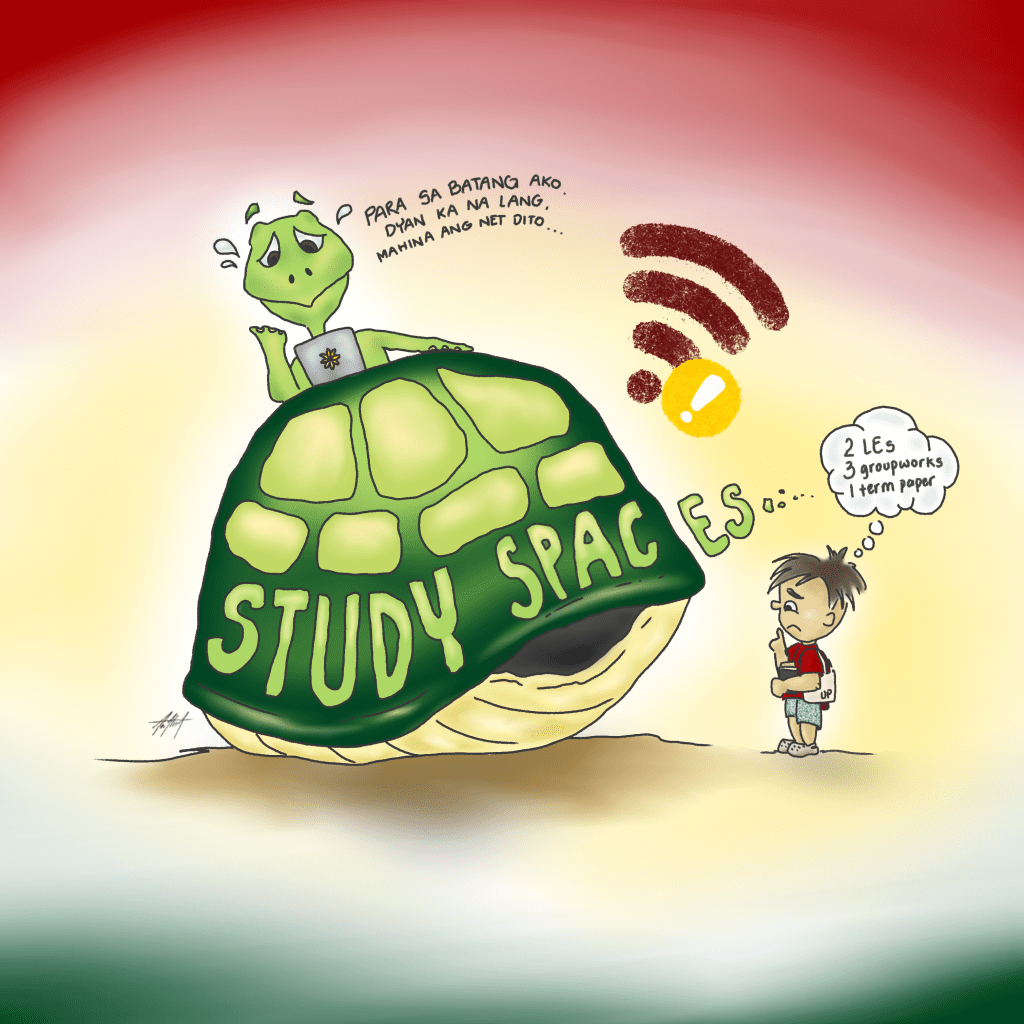
Two years after returning to campus, University of the Philippines Visayas students are still scrambling for something as basic as reliable internet connection and study spaces on campus. Despite the admin’s promises to provide conducive learning spaces, the conditions have only worsened, leaving students with no option but to pay the price – literally.
Struggling with WiFi access
Wifi connections can only be accessible to certain parts of the campus, and frustration among the students has become more common as internet connectivity problems persist mostly at night when students are doing their academic work.
Monique Bactong, a statistics senior who currently resides in Balay Madyaas is frustrated with the slow and intermittent WiFi connection because it hinders her ability to do her schoolworks in the dormitory. She, like many other on-campus dormitory residents, relies on the school’s internet connection to study and complete assignments.
Eunice Tayone, a sophomore of BA in Communication and Media Studies currently residing in Balay Apitong aired her frustrations with their dormitory’s WiFi connection.
“Actually, yung internet sa Balay Apitong madalas nawawala-wala, and may ilang parts ng dorm na hindi talaga naaabot ng WiFi. So the students have to go out of their rooms at magtambay sa study area just to finish their requirements. Kapag nagrereklamo naman kami kay Tita or nagreraise ng concerns about the signal, it takes days pa—one time, umabot pa ng three days bago naayos, lalo na kapag umuulan,” Tayone said.
Students who live off campus are just as disappointed. Rodney Arnolf Opu-an, a BS in Biology junior who boards a dormitory outside the campus, said he often goes to university study spaces, especially when there’s a wide gap between his first and following class.
“Malimit akong pumupunta sa student spaces lalong-lalo na kapag malalaki ang oras na pagitan ng mga klase ko. Nakikikonek ako sa WiFi ng unibersidad at kadalasan ay nag-aaral ako o di kaya ay gumagawa ng mga school requirements,” said Opu-an.
While he acknowledged the strong wifi connectivity in some of the study spaces inside the university, there were still instances of intermittent or lost connection.
Enhancing connectivity means infrastructure upgrade
Engr. Rico Hortillo, IT Officer I of the Data and Information Systems Program (DISP) at UP Visayas, attributed the intermittent Wi-Fi connection to the limited number of access points in the campus and partly due to the old network equipment and fiber optic infrastructure. Engr. Hortillo added that since there are many more students on campus this semester, Wi-Fi usage has become overloaded.
He added that the multiple reports of WiFi outages, especially from dormitory areas inside the campus, was because of equipment overloaded, thus underscoring the need to be not just equipment upgrade but internet infrastructure upgrade as a whole.
“[Kapag] naimplement namin ang fiber optic upgrade and additional WiFi sa mga dorms, pero if same pa rin, problem pa rin yun sa amin. Wala pa man schedule, but may plan man ang UP System to upgrade the bandwidth per [constituent unit], but this time, wala pa naman balita,” Engr. Hortillo added stating one of the remedies is to add access points in the campus.
Engr. Hortillo further noted that currently, the CAS building has an insufficient number of almost 10 access points, which are wireless routers with radios that allow devices to connect to the internet.
“Almost 10 lang ang WiFi points natin sa [CAS building], so i-eexpect mo na hindi niya maco-cover lahat ng WiFi signal for the whole hallway, so if ara ka sa punta wala gid signal. So ang option ta, additional WiFi sa hallway,” said Engr. Hortillo.
This was corroborated by the College of Arts and Sciences Student Council (CAS SC) during their building and laboratory assessment. They reported that out of 46 classrooms and laboratories, 17 had no WiFi access, while 16 had access, albeit with weak signals. Eight classrooms were yet to be assessed.
Students pay the price
In addition to the campus’ internet connectivity issues, students have also expressed dissatisfaction with the lack of available study and co-working spaces on campus, especially during nighttime hours, forcing some to seek and pay for study hubs off-campus.
Tayone shared that when the internet goes down, students are left with no choice but to seek alternatives off-campus. “Although we try to save money, we usually spend around three to four hours at the study hub, which costs 30 pesos per hour—amounting to 90 to 120 pesos each time,” she explained, highlighting the additional financial burden placed on students.
Liwayen Torres, a junior Political Science student boarding in Barangay Malagayan, echoed similar frustrations. “Yung nagdaang buwan, very mahina ang Globe tapos Globe ang gamit namin, tapos wala din kaming signal doon,” she shared. When connectivity issues persist, Torres often resorts to nearby study hubs, where expenses can reach up to 250 pesos a day, including food.
“Gusto ko sana sa TLRC kaso madaming tao at mahina rin yung WiFi doon kaya umuuwi ako with the hope na pwede akong gumawa sa boarding house, kaso mahina din kaya ayun nag-study hub nalang kahit sobrang gastos,” she added.
On hopes and action
While we can only hope for the immediate actions, the situation calls for a more comprehensive and expedited resolution to alleviate the ongoing challenges faced by the UP Visayas students. The persisting issues of wifi connectivity and the lack of enough study spaces reflect systemic shortcomings that demand urgent attention and proactive measures.
The planned upgrades and initiatives to bolster internet connectivity signify a step in the right direction, but a comprehensive overhaul of the infrastructure remains imperative for sustainable solutions.
For many students, the unreliable internet and limited campus study spaces have forced them to seek alternatives off-campus, such as study hubs, adding to their financial burdens. Spending money on these hubs, often at a cost of hundreds of pesos per visit, has become an unfortunate necessity for students struggling to meet academic requirements in the face of these challenges.
As Bactong hopes to graduate at the end of the second semester, she calls for immediate action to this problem in the university.
“Sana mabigyan ito ng priority at maayos as soon as possible dahil nagiging cause ito ng delay sa productivity ng mga estudyante, lalong-lalo na sa pagcomply ng mga requirements. Ang madalas na connectivity issues ay nagiging hadlang sa pagkakaroon ng isang conducive learning environment at the comfort of our own dorms,” Bactong stressed.

Rey Mark Paran is a third-year statistics student at the Department of Physical Sciences and Mathematics. He became a member of Pagbutlak during his first year and was subsequently appointed as its editor. Now in his third year, Rey Mark still serves as Pagbutlak’s editor-in-chief.



 Pagbutlak
Leave a comment