
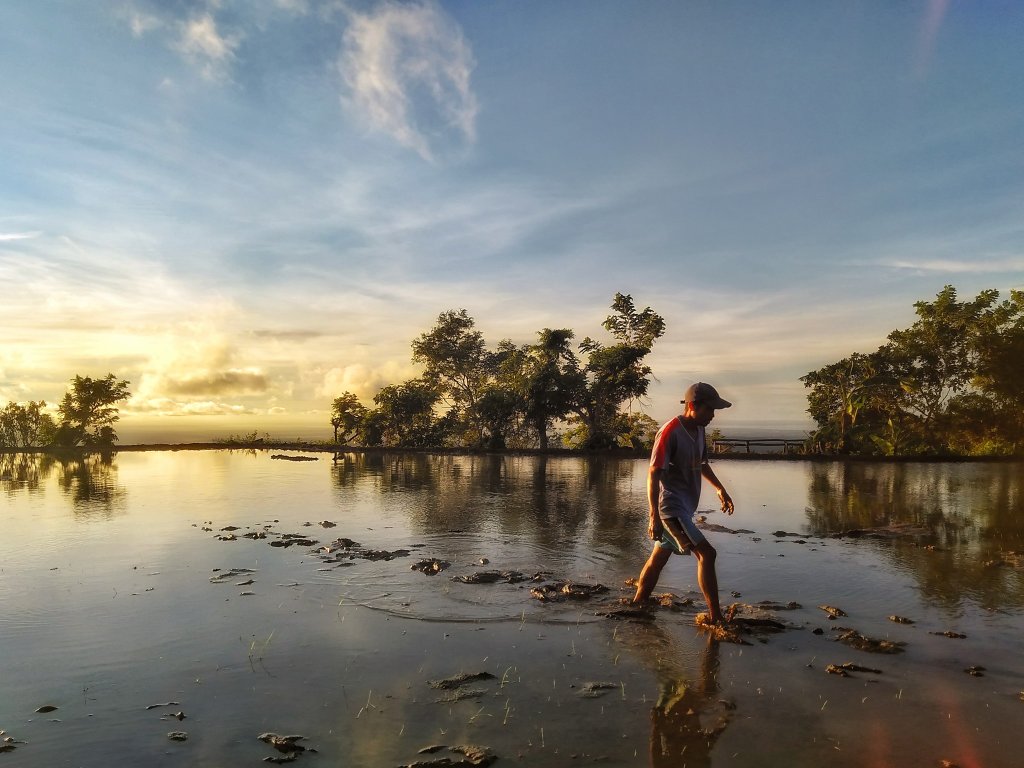
Photo by Franque Gilo/Facebook
In our pursuit of genuine agrarian reform, we carry our dead as we carry our resolve to transform society. We plant them in places where there was previously blood. We never pause. We struggle so the earth becomes pregnant, cracks open, and heralds a day when no peasant will have to earn his place in his land through death.
In the summer of 2019, El Niño wreaked havoc on Miagao, the onion capital of Visayas. It drained agricultural barangays, the great Tumagbok river, and my school. The Miagaoanons, who looked to the sky for guidance, anticipated the waterless season. But, no native astrologer, much alone philosophers in academe, who practiced their own rituals, expected it to arrive sooner. When it struck, the university stakeholders, including me, were devastated.
El Niño left us with a water crisis. But for the peasants beyond our walls, who were driven to pluck their onions from the cursed fields, it was a disaster. Local agriculture watered down. Irrigation facilities dried up. As a consequence, onions sold at a lower price, enough to repay the lords. I witnessed it firsthand.
In the weeks that followed, the water crisis triggered a wave of discontentment among the peasantry, culminating in one of Panay’s largest agrarian protests to date.
Mendiola’s memory
Three decades earlier, a similar protest was met with wanton violence. In 1987, 13 defenseless peasants were slaughtered by state forces after organizing a peaceful assembly in Mendiola to assert their right to land ownership.
The government, led by President Corazon Aquino, faced intense criticism and calls for resignation as the once vibrant and bustling Mendiola became a ghost town, with echoes of gunfire and screams lingering in the air. Protests surged across the country. People were clamoring for justice.
In response, President Aquino implemented a bogus Comprehensive Agrarian Reform Program (CARP) under a similar-sounding statute. It purported to advance social justice and industrialization through agrarian reform. However, CARP fell short of its promise. As a result, our country’s sugar and coconut output dropped precipitously. Poverty incidence among beneficiaries increased, leading to a new social class: the landed poor. No peasant gained genuine land ownership under CARP. Land distribution was kept conservative to safeguard the property rights of landowning politicians.
Mendiola traces the historical struggle of our landless tillers, whose seed started growing during our ascent to feudalism.
The rise of feudalism
Feudalism in the archipelago began during the pre-colonial period. However, one can’t dispute that, during Spanish colonialism in our country, which lasted over three centuries, feudalism was at its pinnacle.
The Spaniards, through the crown and church, usurped the lands of our natives. They accomplished this by borrowing parcels of land, which they later claimed as their own. It didn’t help that these activities were formalized by royal decrees. As if that wasn’t grim enough, the friars waited for the natives to die before grabbing what wasn’t theirs to take, making it the archipelago’s first documented cases of land grabs.
It continued with the Americans, whose so-called manifest destiny bloated their heads with ethnocentric delusions of relevance. The colonial government purchased friar haciendas and handed them up to native elites. They felt obligated to govern the Filipinos. One component of this strategy was to create education as a vehicle for ideological reconfiguration.
Tutelage under the Americans was intended to produce natives who would strengthen American rule throughout the islands. The children of the hacienderos benefitted. They rose to prominence as deft heirs to their second colonial masters. From the Japanese occupation till today, the native elites who run our semi-feudal and semi-colonial society have exploited our peasantry’s lands.
Filipino peasantry
The Filipino peasantry arose from the country’s feudal mode of production, which was defined by the domination of a small landholding elite who controlled the majority of agricultural land and peasant labor. In turn, the peasants were largely reduced to a state of reliance and subservience, with little control over their own lives or access to the means of production. This predicament was exacerbated by a number of causes, including the legacy of Spanish colonialism, which cemented the authority of the landholding elite, and the government’s anti-people sentiment, which did not oppose this domination.
But to say that our peasants had no influence on history is naive. The peasants have repeatedly demonstrated that they are a formidable counterforce—a historical builder of histories—to the hegemonic domination of landholding elites. On several occasions, they have proved their collective power in the face of state-sponsored neglect and aggression.
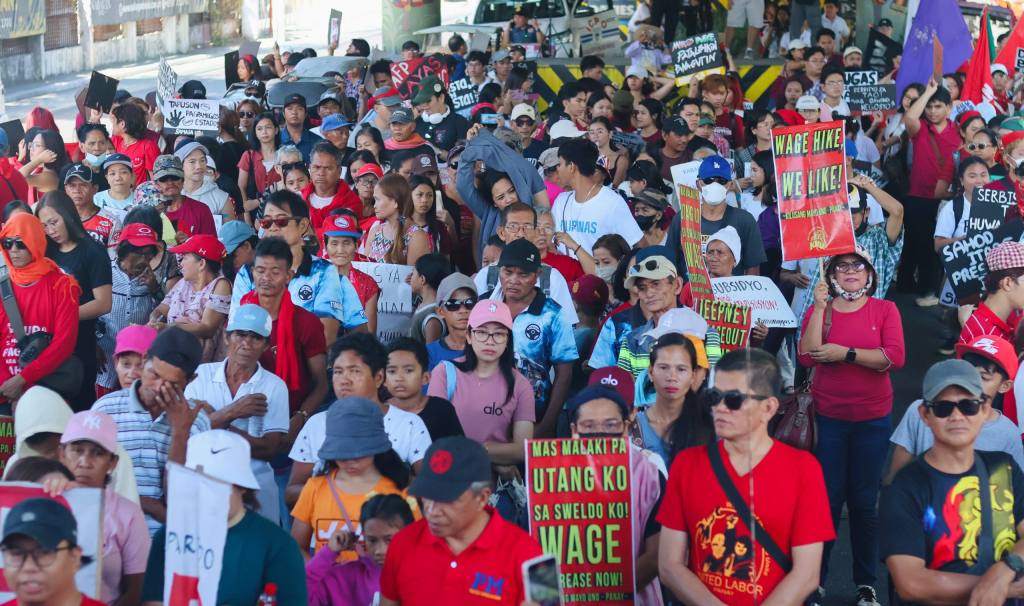
For example, the peasants of Miagao, together with those from adjacent towns, marched to the streets of Iloilo City to demand proper support during the water crisis. It demonstrated the power of the peasantry. Unfortunately, despite their efforts to improve their lives, the age-old fight for agrarian reform, which Mendiola battled tooth and nail for, did not result in genuine land distribution.
Nonetheless, in Miagao, peasant leader John Farochilin continued the fight.
A peasant’s burden
The Mendiola Massacre was an onion with layers upon layers of injustice. On the surface, it appeared to be a violent fight between peasants and state forces. Peeling back the layers reveals a narrative of poverty, oppression, and the struggle for land rights. The same layers covered the lives of John and peasants in Miagao who endured the extremes of the water crisis.
John, or Tay John, was a five-foot tower of strength and optimism, small in stature, with skin worn down by natural forces and hands calloused by labor. What he lacked in physical strength he made up for in his commitment to upholding and defending peasant rights. He didn’t mind the scorching heat of the summer when he and hundreds of others marched to the Iloilo Provincial Capitol to seek assistance during El Niño. Neither did he give in as he stood in the line of fire to protest widespread hunger and state fascism. It would have been simpler if he had sat at home, let others fight for him, and watched the state maul his comrades, but he did not—he could not.
A chairperson of Alyansa sang mga Mangunguma sa Miagao (AMM) and a council member of Paghugpong sang mga Mangunguma sa Panay kag Guimaras (PAMANGGAS), Tay John opposed the defective Comprehensive Agrarian Reform Program Extension with Reforms (CARPER) in both the city and the countryside.
Under President Rodrigo Duterte, CARPER, which amended the earlier CARP, dealt a blow to our peasants. Instead of returning the lands to them, CARPER continued what its predecessor had done. It required peasants to pay a monthly amortization, failing which they would be forced to resell their lands to lords. Worse, lands owned by political families such as the Arroyos and Cojuangcos would only be distributed to them if CARP had accomplished 90% of its target, which is, to say the least, unrealistic. Nothing in CARPER guaranteed genuine land distribution. If any, it has exacerbated the landlessness that our peasants have faced since Spanish colonialism.
At the height of the water crisis, while we in the university were mounting our own protest, Tay John led a strong peasant stream towards the capitol. He battled—fought long and hard against the interests of landowning elites—only to win a short victory.
Tay John and I did not share the same type of worry. But we had once been connected by the same land. Our feet have walked on the same ground. Our eyes have seen the same fields. And our lips have uttered the same battle cry: lupa, hindi bala (land, not bullets).
Unfortunately, a year after the water crisis protest, Tay John was found dead in Sitio Anoy, a hamlet in the Miagao hinterlands, with many gunshot wounds in his body. The 61st Infantry Battalion of the Armed Forces of the Philippines murdered him in a staged encounter. For all Tay John had gone through, his unjust death sting the most, like an onion to the naked eye.
Today, I remember Tay John by his principles: commitment, conviction, and consistency. I honor him by taking into heart the words he left me, “halong…padayon” (take care…carry on).
Genuine agrarian reform
In our pursuit of genuine agrarian reform, we carry our dead as we carry our resolve to transform society. We plant them in places where there was previously blood. We never pause. We struggle so the earth becomes pregnant, cracks open, and heralds a day when no peasant will have to earn his place in his land through death.
We are under a new regime. Our peasants from Mendiola and Miagao can only hope for fair treatment. But, knowing the history of the master landlord, Ferdinand Marcos Jr., as well as the colonial and feudal relations that govern our society, hope can only go so far. Only the sickle, forged by the labors of our tillers and sharpened by their historical collective resistance, can cut through Malacañang’s paper tiger.
The sickle represents many forms of resistance. One of them is genuine agrarian reform. GAR, unlike CARP and CARPER, which were only concerned in perpetuating land monopolies for the small few and allowing foreign firms control over our land, aspires to develop and modernize our agricultural sector in ways that benefit our peasants, as well as distribute land to them. It is a key factor in fostering genuine national industrialization and growth.
The Mendiola Massacre serves as a reminder that agrarian reform is not always easy or peaceful, but it is always worthwhile to strive for. The peasants who were present that day, and those who continue to carry on their memory, are like the layers of an onion in Miagao and throughout the country. Each one may be little and inconsequential on its own, but when combined, they form a strong force capable of overhauling our current semi-colonial and semi-feudal society.
Mendiola. Miagao. Separated by seas. Divided by time. United by one struggle for genuine agrarian reform. To Tay John and the peasantry of our nation—no lord owns you but your land.
Phillippe Tanchuan is a published author and a graduate of UP Visayas with a degree in Sociology-History. He served as the features editor of Pagbutlak during its 48th year.



 Pagbutlak
Leave a comment