
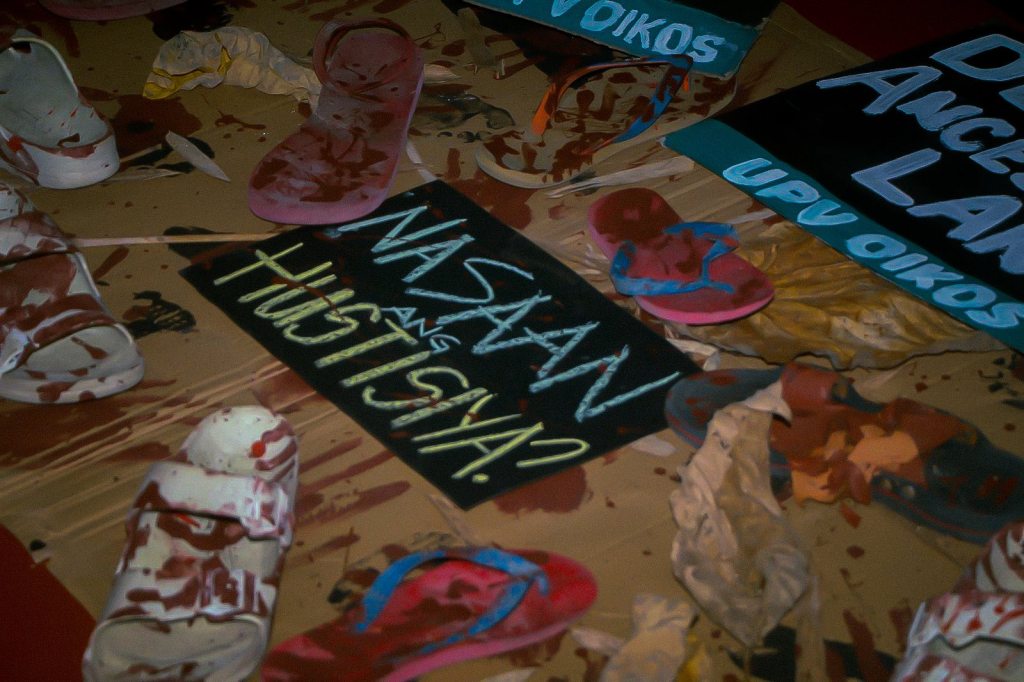
Photo from UPV Oikos Ecological Movement/Facebook
‘The Tumandok of Panay is among the IP groups that have struggled for a long time and did so against the lucrative Jalaur Mega Dam’
Every October, Indigenous Peoples’ Month is celebrated in the country to promote awareness of our indigenous peoples. But, in recent years, it has been marked with horror as state terrorism continues to beleaguer indigenous groups.
As of March 2018, the IP was the second-highest victim of extrajudicial killings in the country. Duterte’s second year in office had registered 21,966 forcible evacuations; more than 100 trumped-up charges; 62 illegal arrests; 37 extrajudicial killings; 34 forcible closures of schools; and 21 political prisoners.
In February of the same year, the Aetas in Porac, Pampanga received threats and harassment from a local political family and police officers after they barricaded their ancestral domain to stop quarry activities. Eight Lumads at Brgy. Ned, Lake Sebu in South Cotabato were killed by state forces in 2017 after they had been red-tagged as rebels.
These abuses reflect the government’s true priority — profit over people. The Tumandok of Panay is among the IP groups that have struggled for a long time and did so against the lucrative Jalaur Mega Dam.
The Jalaur Mega Dam was conceived in 2009 when government agencies studied the feasibility of constructing a mega-dam in Calinog, Iloilo. The result was forwarded to a Korean firm two years later. However, throughout the planning stage, the Tumandok were not consulted, which violates the provision of the United Nations Declaration on the Rights of Indigenous People (UNDRIP), stating, “no relocation shall take place without free, prior, and informed consent of the indigenous people concerned.”
The Tumandok were forced to sign waivers and sell their lands. Those who had refused were charged with expropriation by the National Irrigation Administration (NIA).5 While the construction was ongoing, they were offered temporary jobs. But, the Tumandok remained firm in safeguarding their lands, understanding the irreversible environmental impacts of mega-dams.
In 2012, Advocates for Science and Technology for the People (AGHAM) conducted an environmental investigation in Tumandok’s ancestral domain, noting its rich and abundant natural resources. They found out that the mega-dam is located just 11 kilometers away from the West Panay fault line, which is a recipe for mass destruction.
As a result, the Tumandok formed the Tumanduk nga Mangunguma nga Nagapangapin sang Duta kag Kabuhi (Tumanduk Farmers in Defense for Land and Life) or Tumanduk alliance to amplify their concerns and express resistance against the Jalaur Mega Dam. Unfortunately, more than a decade later, their demands fell on deaf ears.
On the 30th of December 2020, nine Tumandok leaders were massacred while 16 others were illegally arrested in what state forces described as a “Synchronized Enhance Management of Police Operation.” Two weeks before, the Tumandok were red-tagged and accused of colluding with the Communist Party of the Philippines (CPP) and the New People’s Army (CPP-NPA). Their alliance was flagged as a front organization of the CPP-NPA during a senate meeting. Among the slain was Roy Giganto, a kagawad of Barangay Lahug and the chairperson of Tumanduk. Reynaldo Katipunan and Mario Aguirre, officials from the same village, suffered the same fate.
Police officers claimed that those executed and detained were “resisting arrest.” It led to an “encounter” that killed several Tumandok. However, civil society organizations, such as the National Union of People’s Lawyers Panay (NUPL-Panay), refuted the officials, asserting that the operation was “nothing more than an excuse” to massacre and arrest Tumandok leaders who were actively fighting for their rights and welfare. Fr. Marco Sulayao, chairperson of the Promotion of Church Peoples’ Response (PCPR) in Panay and Guimaras, accused the National Task Force to End Local Communist Armed Conflict (NTF-ELCAC) of being the mastermind behind these killings. AGHAM posited that this tragedy was a “manifestation of the dangers of red-tagging.” According to the Youth Act Now Against Tyranny Panay (YANAT-Panay), these killings were not meant to purge the communist insurgency. It was to silence dissenters who were critical of the government.
Almost two years after the massacre, justice remains elusive. The Tumandok are still being intimidated by the Armed Forces of the Philippines (AFP) and the Philippine National Police (PNP) while the culprits behind the massacre are roaming scot-free. Despite the abuses the Tumandok and their allies had experienced and are still facing, they continued to stand firm and press on.
Through the collective aid of their families, supporters, and legal counsel, 15 of the 16 Tumandok who were illegally arrested have been released a year after the massacre. On October 28, 2022, Rodolfo Diaz, a 75-year-old Tumandok member, was temporarily released from jail after almost two years. The truth of that horrific December morning prevailed.
On the 2nd anniversary of the Tumandok massacre, a book launching of “Land and Life: The Tumandok People of Panay and their Struggle” and a solidarity program was held. This program seeks to commemorate the life and struggles of the Tumandok People of Central Panay and further share their experiences on what it is like to live their lives. Various advocates and supporters of the Tumandoks also expressed their solidarity during said program. Progress was made. But is it enough? Time will tell.
For now, there can be no true celebration of the indigenous peoples unless state terrorism ends and those who commit or support such acts are punished. Two years have passed since the Tumandok Massacre, let us not forget the long-standing Tumandok struggle. Let us stand with them and the rest of our indigenous peoples in demanding genuine justice.
Hustisya para sa Tumandok!
FRANVILL VILLANUEVA & KHYLA NICOLE ABUZO



 Pagbutlak
Leave a comment