
Graphics by: Art Antaran
There will always be manufacturers. There will always be fast food chains and restaurants. There will always be department and grocery stores. But there must not always be a disparity in surplus value.
Do you ever find yourself craving the aroma of freshly chopped white onions, harmoniously balanced with the succulent juiciness of beef, delicately topped with mustard and a hint of calamansi?
What if I tell you: your hunger can be weaponized? What if our collective affinities for food is a manifestation of the current systems that starve us?
From Mother to Mother: A Recipe worth Revisiting
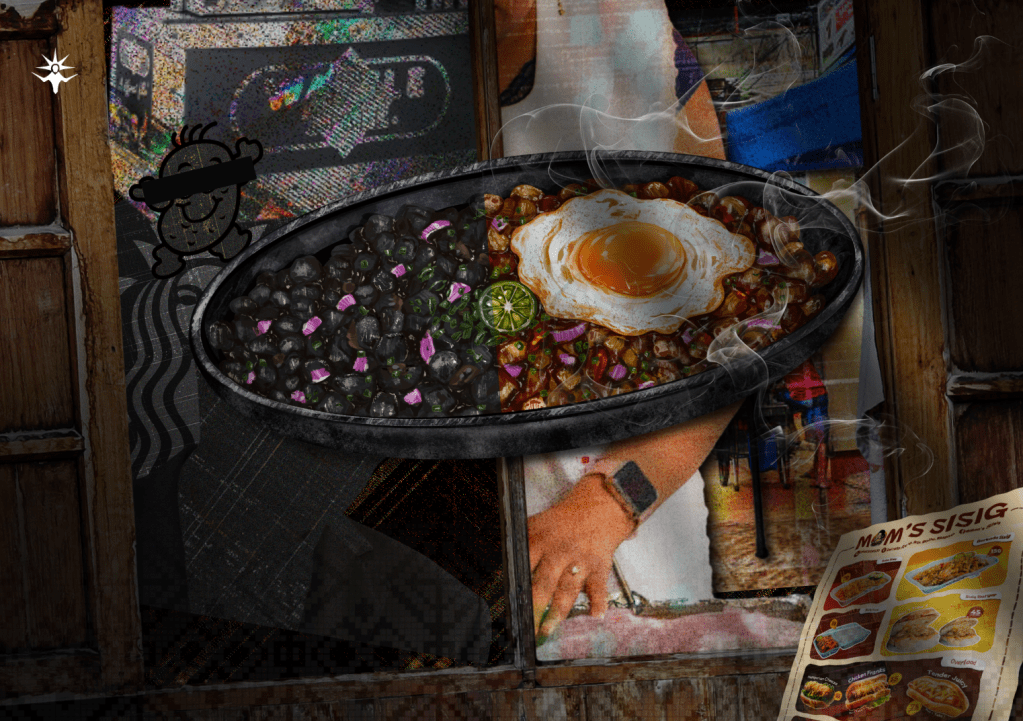
Towards the heart of Miagao, beside the narrow streets of boarding houses, the familiar smell of Mom’s Sisig guides not only the stomach but the hearts of everyone to enjoy its unique and addictive flavors. From mother to mother, the Kapampangan recipe resisted an abusive household and reflects the resilience of women and the family-centered chokehold of a Filipino household.
The flavors hold the struggles of a single mother to sustain her children—waking up each day with just the persistence of prayers as “puhunan.” Mouths are filled and stomachs have stopped churning as Mom’s Sisig became the town’s nucleus for affordable yet portion-surplused meals.
“Dapat po Mommy Conching’s Sisig pero nilagay ko nalang Mom’s Sisig kasi halos karamihan sa atin mga Pinoy, bata man o matanda ay mahilig kumain ng sisig. Kahit ano [ang] okasyon, kadalasan may sisig.”
However, the family’s euphoric expansion was faced with backlash as a recent anonymous post in the UPV Community Facebook Group noticed the deficit to the portion sizes in the current servings of the small stall. Just like their perceived portions, the number of customers, most specifically the sector of UP Visayas students also decreased.
While it was addressed swiftly by the business’ official Facebook page, the anonymous user have established a disconnect between the food that once replenished the energy of students with its motherly warmth, leaving us unclad to perceive the underlying problem of the food industry—when the platter is opened, what awaits us is the mechanical prototype of what is food in the Filipino culture.
We are not only facing a food crisis. We are facing an intersectionality of inadequacies in our industries that cascades in our everyday spheres.
Cravings Satisfied?
There is a common misconception that companies invest in their products or services. Yet in reality, it is in embedment of a craving to their target market population that leads to the symbiotic relationship, an insuppressible need, between the product and the buyer.
There is a subtle knowing in buying a particular product—a joy in offering money to get a pair of Nike’s rather than being offered a pair of Crocs; to enjoy a buffet in Vikings instead of enjoying caldereta and pancit during birthdays; and in indulging in the seemingly unending sugar rush of Dairy Queen when compared to getting a 10-peso dirty ice cream. It is a subconscious yearning configured by marketing and advertisement specifically made to induce an automatic reach of a hand in the nooks of a grocery store.
Just like there is manipulation in the media, the distortion in our decision making and fine tuning it to align to the majority is a byproduct of capitalism. Everything is political—even what you eat, where you dine, and who accompanies you to finish a meal.
Why does this matter? This means that our 10 PM cravings are not ours alone. We share our platter with big corporations that dictate what stores we spontaneously go to up until as to what the menu offers.
Take this, the recent clamor for a franchise of Potato Corner to be installed in the halls of CUB is a primary example of how deeply we have been tranquilized to induce a food coma.
We have overlooked the fact that it is not the soft granules of flavoring we worship – in their endless reservoir of cheese, sourcream, chili barbecue or even cookies and cream–that burst in our mouths convulsing with its saltiness and enigmatic smell creating the taste of a feeling irreplicable; but, whom we really give our devotion to are the gluttonous enterprises they came from, not the bulk of sliced potatoes and heaps of seasoning.
Hence, it is a testament of the created gap in the reach of small vendors such as Mom’s Sisig to advertise, influence, and popularize their products. Leaving them underground with all the unrecognized fishball stores, buko juice sellers, and pandesal sellers with their soon to be expired food not made with the help of factories but of consistent dawns brought about by crooked backs and burnt hands.
“Big struggle sa akin as business owner and solo parent ay yung masimula ng kabuhayan ng walang ng walang sapat na puhunan. Matinding tiis ng pagod at puyat para mapaunlad at masurvive ang business. Walang day off, walang helper, kasi sayang ang income, [kailangan habaan ang] pasensiya para makapagpaikot ng maayos sa puhunan.”
Whose pockets are emptied and whose bellies are filled?
In contemporaneity, the struggle is also found not only in the buyers but in the politician and the business owner. Devolved from its promise on empowering agrarian communities, giving our farmers the right funding and equipment, the current food systems in the Philippines focus on international monetary relationships and outcomes leaving our farmers with husks for dinner; our fisherfolk with the accumulated salt in their skin and heavy lungs after a 4:00 am dive traversing cold and guarded seas; and our karinderyas, that with every tawad there is a pocket undressed.
“Malaki [ang naging] epekto samin dahil sa kita namin nababawas pag tumataas [ang] presyo ng mga sangkap. Ayaw ko na itaas ang presyo at i-maintain lang para affordable pa din sa lahat. Dinadaan ko nalang sa volume at bilis ng pagbebenta. Basta maraming bumibili kahit maliit ang tubo kikita pa din.”
In small businesses, when labor is not only done by the owner and their close relatives, the locals in the community take on roles with less than minimum pay. While big corporations and fast food chains rely heavily on private ownership and incentivized labor, our local artisans sometimes live through leftover cash and most times through compassion or even “utang ng loob”. These normalcies are apparent in the everyday dilemma of Mom’s Sisig on whose deflated stomach to prioritize: theirs or their customers.
But, is it really a question on whose pockets are worth emptying? We are no different from each other. Customers, vendors, small business owners—we are all part of an encroached economic and political platter filling the bellies of pigs we cannot wait to butcher.
Beyond Business, Towards a Kind Caress
In the peak of this hopelessness, what emerges is kindness. In a society where our basic needs are wrapped with powerplay and personal interests, the common Filipino still welcomes every customer with a smile and a warm hand—our farmers with cracked backs; our fisherfolks with liquefied lungs; our tiangges with overdue debts; and our street vendors with worn-out calves. They reflect an enduring purpose but also an enduring truth: as long as there is someone starving in the streets there will always be someone to share even a heap of their less than enough meal.
Compassion has always been the forefront of Mom’s Sisig. It was not the recipe nor the price that kept people coming but the authenticity and commitment in serving whoever visits them: whether at the dawn of half-drunk Saturdays or at the dusk of hellweeks when exams pile up with no decent dinner in the dorm.
“Malaki ang naitutulong ng UP students sa Mom’s Sisig dahil malaking percentage ng sales namin halos puro students simula ng magstart kami magbusiness. Dahil sa pagtangkilik ng UP students sa Mom’s Sisig nasustain ko ang lahat ng kailangan ng mga anak ko para sa pag-aaral at pang-araw araw na pamumuhay namin.”
Why then do we have an affinity to fast food chains rather than our own homemade meals? Why then do we view local products as lesser? Why then do we pit ourselves against each other when we all have a collective hunger?
There will always be manufacturers. There will always be fast food chains and restaurants. There will always be department and grocery stores. But there must not always be a disparity in surplus value—the hours we spend working are higher than the pay we get only to make the rich richer and the poor poorer.
Underserved but Now Heard
Small businesses just like Mom’s Sisig are underserved because they are needed to be: the relatively lower option when the all time favorite question is asked: “Ano gusto mo kan-on?”
While food on the streets are considered cheap, big businesses thrive on how glorified and exclusive they can be, strengthening the borders of social classes and decreasing mobility to go against what is supposed to be a gradient now a rigid line.
Employing these ingredients, the ruling class maintains power sometimes not through force, but through consent as their secret ingredient—an heirloom passed through generations of political dynasties. In making exploitation through deception “normal” and common sense, we are the ones slowly being eaten.
With these concerted complexities, as scholars and as intellectuals, we must not always blame the establishments for a price hike in our favorite commodity. Now more than ever, there is a need for compassion and dissection of a 10-peso increase. Blaming Mom’s Sisig does not make us woke for speaking up, it only justifies how passive we are even in our food choices.
The Filipino people are starved. Contrary to our abundant reserves of natural resources and fiestas, in our every meal, there is struggle. For every adobo, kare-kare, and lechon, we are yet again reminded of our colonial past and the revolutions that have gotten us to democracy–an induced hallucination: no nation is ever free. No mind is ever unbiased. No hunger is ever satiated.
“Teh, diin ta makaon?”
Sheina Elijah B. Penetrante is a sophomore of BS in Public Health in the University of the Philippines Visayas. She is the Feature Editor of Pagbutlak in its 51st year.


 Pagbutlak
Leave a comment