
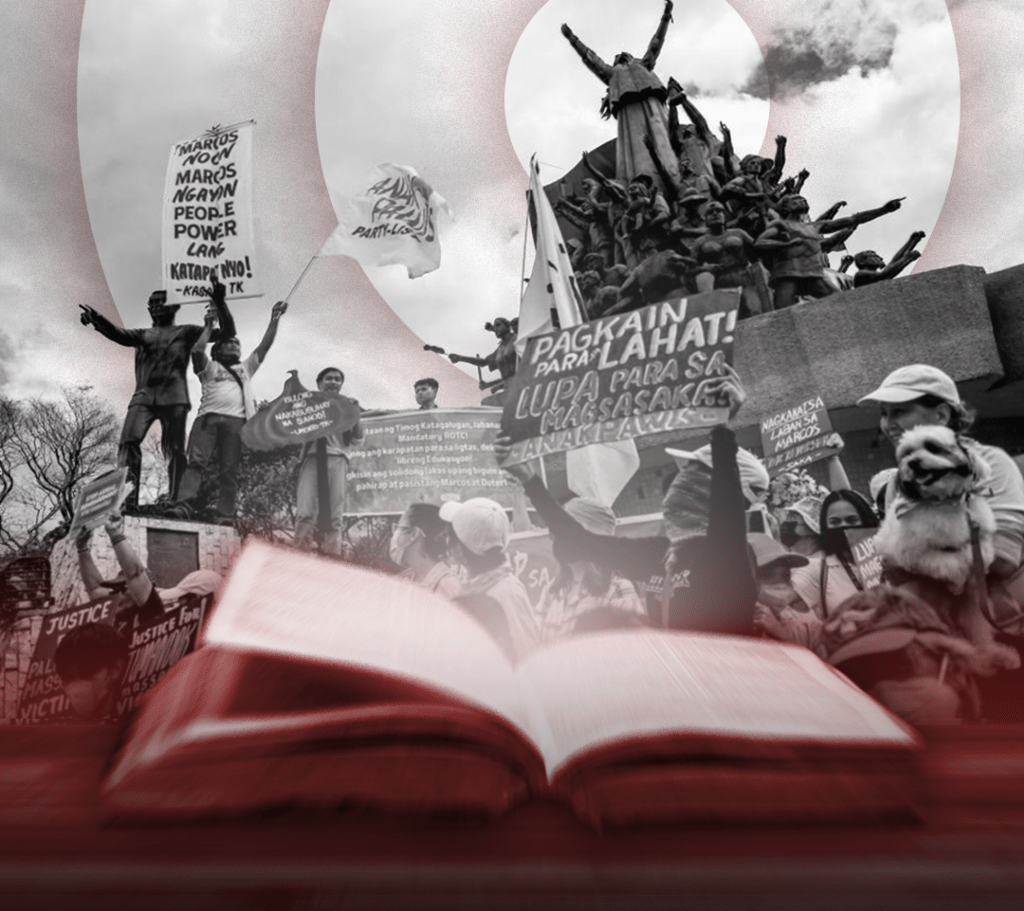
Memory keeps the departed alive. To remember is to immortalize the dead, to honor what they fought for. To forget is to kill them a second time. A nation is only as strong as what it remembers. And what, if anything, can save us, is the refusal to forget.
When I was ten, democracy sounded like a fairytale. That was the closest I came to a love story — at least the way I understood it. It begins with promises that if you give yourself fully, even through struggle and heartbreak, it will not betray you. That was what my teachers repeated in class, the definition written in our textbooks: the people hold the power, leaders serve with integrity, the government is of the people, by the people, and for the people.
I believed this with the same innocence children believe in happy endings, in the good always winning in the end. My version of that fairytale was the day our teacher made us watch a grainy black-and-white video of the EDSA People Power Revolution. There I was, in my blue-and-white uniform, sitting on a wooden chair, watching nuns clutch rosaries and men perch precariously on lampposts. Millions of Filipinos filled EDSA from curb to curb, shoulder to shoulder, forming a human barricade against a dictator. Every step they took was a leap forward for democracy.
The facts came in bullet points: Two million Filipinos stood united. Epifanio de los Santos Avenue. February 22-25, 1986. Against a dictator, Ferdinand Marcos Sr. Martial Law declared on September 21, 1972. The dictator fled, and democracy was restored.
“We like to think we taught Filipinos democracy,” CBS anchor Bob Simon reported from New York in 1986. “Well, tonight, they are teaching the world.”
I thought we were the good guys who had beaten the bad king. I felt a swell of pride and smiled. That was how the story began in my mind: once upon a time, we were heroes.
I believed that democracy had drawn a line, that cruelty would never cross without consequence, and if it dared, my fellow Filipinos would see it, resist it, and rise, again and again, to condemn it.
I believed it even when a classmate leaned over and whispered, “Man-an mo man nga golden age ang Martial Law?” I laughed. There was no way silencing dissent, stealing from the nation’s coffers, torturing people in all its forms could ever be called a golden age. I assumed everyone shared that basic moral understanding.
I believed it even through Arroyo’s scandals, the Pork Barrel scam, and the Mamasapano clash. I believed it during the drug war when men were gunned down in the streets, their bodies wrapped in tape and left on the road. Dare I say, I believed it even in 2022, when 31-million Filipinos returned a Marcos to the highest office, cheering for the very name it had once overthrown. I kept rationalizing, insisting like a mantra that this time would be different.
And I stubbornly believe it still, even here in a university long known as the forefront of activism and academic freedom. I should feel optimistic about the democracy’s promise. Instead, I see its cracks daily in the people who still find the grace to treat others with the dignity the state denies them.
The tricycle driver who hunches over his handlebars, waving me back to return the extra change I had forgotten, does not go home to a mansion. The vendor who slips an extra serving of kaldo into my cup when she hears I skipped breakfast still counts coins that will not last the week. The delivery rider who pushes through the rain to bring food to students like me earns barely enough to fill his gas tank. The security guard slumped on a plastic chair, eyes heavy from lost sleep, still manages a smile and a greeting, “Good morning, ma’am” – even as he takes double shifts to pay for his children’s tuition.
These are the people whom kleptocratic politicians rob. They are the faces I see each day. And if these few bear such quiet burdens, how much more for the countless others I do not see?
I had to reconcile the belief I built at ten with the world I see now. Democracy is no fairytale. More often, the good guys lose, and there are no happy endings. I was a kid when I believed in the certainty of a brighter future. I am here to report the murder of that dream — corrupt politicians and those who enabled them have killed it.
It gets even harder now when history can be rewritten with a well-cut video or a trending vlog. Memes, hashtags, viral clips. Our discontent circulates, but it dissipates just as quickly. Politics becomes theater, a spectacle of clowns who understand that publicity, good or bad, is still power. We know something is wrong; we see it, for example, in the recent reports of the ghost flood-control projects. But why do the same names return, election after election?
How did we become a nation that forgot the price of our freedom? 70,000 jailed, 34,000 tortured, over 3,000 killed — more if you count the undocumented ones. With rosaries and rage, two million Filipinos marched, scratched and clawed their way to victory, and forced tyranny to its knees.
Memory keeps the departed alive. To remember is to immortalize the dead, to honor what they fought for. To forget is to kill them a second time. A nation is only as strong as what it remembers. And what, if anything, can save us, is the refusal to forget. Defiant. Unapologetic.
And yet, we let it slip away and every time we do, a part of ourselves dies with it. It settles heavy in my chest as I walk around the campus in my casual clothes, Sablay lanyard around my neck. I rage, even if all I can do is open my notebook, grip my pen, and write.
I look back at that grainy video of the EDSA People Power Revolution, and I understand now what I did not as a child: they were not people with superpowers. They were ordinary Filipinos who summoned extraordinary courage when it mattered most. I sigh heavily, thinking: at least, once upon a time, we were heroes.
Rea Ellen Bastian is a second-year BA Literature student at the University of the Philippines Visayas. She writes opinions for Pagbutlak. As a budding writer and campus journalist, she is passionate about examining social issues, historical narratives, and cultural discourse through a critical lens.

 Pagbutlak
Leave a comment